























Watch one short ad and play ad-free for 30 minutes.
We Become What We Behold
Nicky Case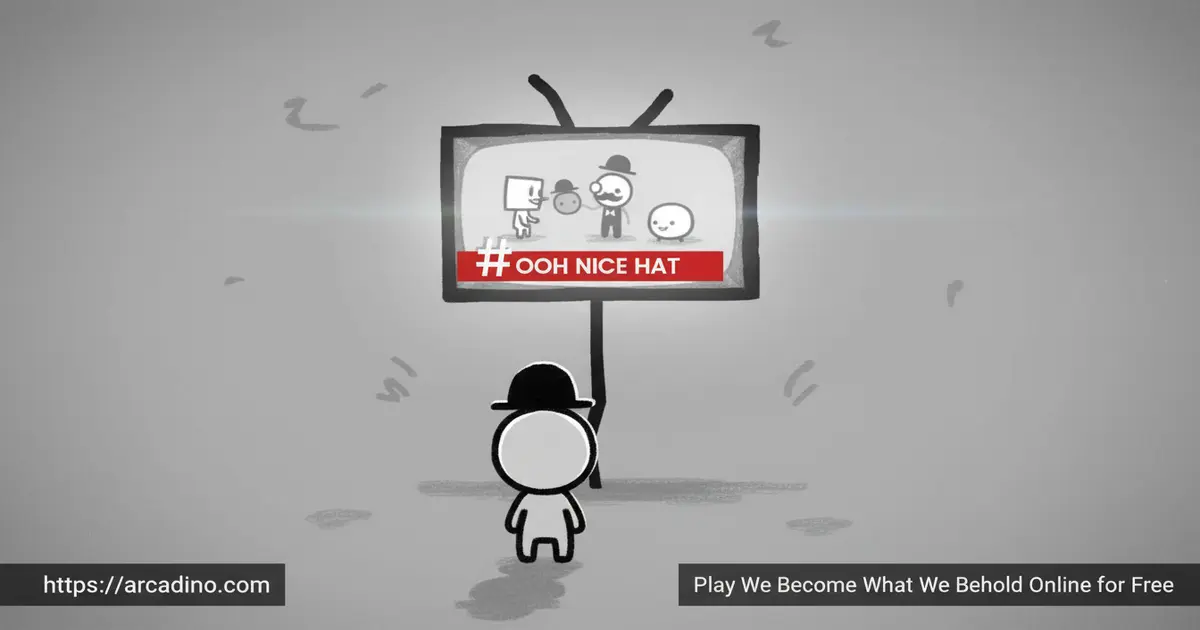
What if the camera in your hands could destroy a whole society? We Become What We Behold is a free browser game that puts that chilling idea front and center. You play it online instantly at arcadino.com — no download required. It’s a five-minute experience that will stick with you a lot longer than five minutes. 🎥
This point-and-click simulation asks a sharp question: does the news reflect the world, or does it reshape it? Every photo you take feeds into a screen that the little characters watch — and what they watch changes how they behave.
- Five-minute runtime that packs a genuinely surprising punch by the end.
- Chain-reaction gameplay where a single photo can flip an entire crowd’s mood.
- Hand-crafted by solo developer Nicky Case, who released the full source code to the public domain.
- A media-literacy message wrapped inside a casual point-and-click format kids can jump into immediately.
What Is We Become What We Behold?
We Become What We Behold is a casual point-and-click simulation game about news cycles, vicious cycles, and infinite cycles. The game opens with a quote that sets the whole tone: “We become what we behold. We shape our tools, and then our tools shape us.” Developer Nicky Case built it in two months and released everything — code, art, and sounds — to the public domain.
What makes it stand out is how its message and its mechanics are the same thing. You’re not just reading about how media distorts reality — you’re doing it with every click. The game loads almost instantly in a browser tab and responds to mouse input with zero noticeable lag, which matters when you need to frame the perfect shot quickly. It’s a remarkably clean HTML5 experience for something carrying this much conceptual weight.
Gameplay — Photographing a Society Into Chaos
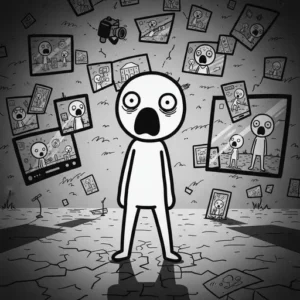
The screen shows a small world of characters with square and round heads wandering around. Your job is to drag a camera viewfinder across the scene and click to capture a photo. That photo immediately appears on a monitor that all the characters can see — and they start copying, reacting, and changing based on what’s on that screen.
At first, everyone is just normal. But the game nudges you toward interesting subjects. A Fancy Man With A Hat strolls in, and he’s hard to ignore. Photograph him, and suddenly everyone either wants a hat or wants nothing to do with hats. The crowd shifts fast. Each snapshot triggers a chain reaction, and those reactions stack on top of each other as the game races toward its ending.
Here’s a detail that makes the game really clever: what you leave out of the frame matters just as much as what you put in it. Choosing to ignore a positive moment — say, two characters getting along — is itself an editorial decision. The crowd never sees what you don’t photograph. That’s how real media works too, and the game makes you feel it firsthand.
Characters and the Chain Reactions They Cause
The cast of We Become What We Behold is small but every character carries a different social weight. The Couple in Love, once photographed publicly, gets shamed off the streets — because apparently nobody tunes in for sweetness. The Angry Person is the real turning point. The game actively urges you to catch them doing something, and once you do, things escalate fast.
Anger and fear spread through the crowd much faster than love ever could. The squares and circles start turning against each other. Normal peeps become increasingly afraid, snubbing their neighbors and radiating hostility. What started as a gentle stroll through a cheerful little world becomes something much darker — and the game makes it clear that you pointed the camera.
There’s also a sneaky chain reaction tied to the Normal Peeps With A Hat. Once you photograph ordinary characters who’ve picked up the hat trend, the crowd notices them — not the Fancy Man anymore, but regular folks just like themselves. That second wave of hat photos hits differently. It shows how a trend stops feeling like something fancy and starts feeling like peer pressure. It’s a separate beat from the Fancy Man shot, and it changes how quickly the group shifts its identity.
Graphics and Audio
The visual style is deliberately simple: flat shapes, a mostly black-and-white palette, and chunky pixel-adjacent characters. That simplicity is part of the point — the game strips society down to circles and squares so you can watch the dynamics clearly. There’s no distraction from fancy textures. Every expression change and crowd shift reads instantly.
The audio matches the tone: low-key and unsettling in the right moments. Nicky Case used Creative Commons sound assets, all of which are credited in the game’s public GitHub repository. The overall package is lean and intentional — nothing feels accidental about how this title looks or sounds.
How to Play We Become What We Behold
Jump straight in at arcadino.com and the game loads within seconds. There’s no tutorial screen to sit through — the opening quote fades in, the world appears, and you’re holding a camera. Look for characters doing something noteworthy and drag your viewfinder over to frame the shot.
The game lasts around five minutes from start to finish. Don’t rush every shot — sometimes waiting for the right moment makes a photo land harder in the crowd’s behavior. The ending arrives on its own, and it’s worth seeing through to the last frame.
Controls for We Become What We Behold
Controls are as simple as it gets. Drag the camera indicator around the screen with your mouse to aim. Click to take a photograph. On mobile, tap and drag to position the viewfinder, then tap to shoot. That’s everything — the entire game runs on point-and-click.
Tips and Tricks for We Become What We Behold
- Photograph the Angry Person while they’re actively yelling. The game won’t let the scene progress properly until you catch them mid-action — don’t just snap a static shot.
- Watch the monitor screen between shots. The characters react to what’s displayed there, so reading the crowd’s mood after each photo tells you what’s coming next.
- Try photographing positive moments first on a second playthrough — capturing the Couple in Love early changes the pacing of how chaos unfolds.
- Pay attention to crowd density shifts. When squares and circles start clustering or scattering, a big reaction is about to hit — that’s your cue to aim carefully.
- Let the scene breathe. Waiting for a genuinely unusual interaction before clicking often leads to stronger chain reactions than snapping randomly at whoever walks past.
Key Features of We Become What We Behold
- A fully playable five-minute story with a clear arc, a defined cast, and an ending that earns its impact.
- Photo-driven cause-and-effect mechanics where every click directly shapes how the circle and square characters think and behave.
- Public domain source code and art — developer Nicky Case released everything freely, making it one of the most openly shared browser games around.
- A non-partisan media-literacy theme that examines how news cycles amplify small differences into something monstrous.
- Zero paywalls or progression gates — the complete experience is available the moment you open the game, from the opening quote to the final frame.
- Released in 2016 — Nicky Case launched the game in November 2016, and it has been freely playable in browsers ever since.
Where to Play We Become What We Behold
The easiest way to play is right here on arcadino.com. The browser version runs on any modern desktop or laptop without any download or account. It’s the same complete game, accessible without restrictions.
An unofficial Android port is also available. You can grab it from the Google Play Store here: We Become What We Behold on Google Play. Note that this is an unofficial port — not a release from Nicky Case directly. If you come across APK files for this title on third-party sites, stick to the official Play Store link to keep your device safe. No iOS App Store version is currently available.
Technical Compatibility and Self-Hosting
The game runs smoothly in all major modern browsers — Chrome, Firefox, Safari, and Edge all work without any extra plugins or settings. It’s built entirely in HTML5, so as long as your browser is up to date, you’re good to go. Because the full source code is released to the public domain on GitHub, technically savvy users can actually download and self-host the entire game on their own server or run it locally from their computer. That means educators, developers, or parents can set it up on a school network or intranet without needing an internet connection after the initial download. It’s one of the few browser games where full offline use is genuinely possible and completely legal. For most players, though, loading it through arcadino.com is the fastest and easiest option — no setup needed at all.
For Parents
We Become What We Behold carries a content warning from its own developer: scenes of snobbery, rudeness, and mass murder. The violence is abstract — shapes clashing on a flat screen — but the theme of societal breakdown is real and intended. The game is best suited for ages 12 and up, ideally with a short conversation afterward about what it’s saying about media and news.
There’s no chat, no in-app purchases, and no accounts to create. The whole thing runs in five minutes, making it easy to supervise. Older kids who are curious about how social media and journalism shape public opinion will find this title genuinely thought-provoking. It’s the kind of browser game a parent and child could play together and have a real discussion about afterward.
For Teachers: A Ready-Made Media-Literacy Tool
Teachers looking for a quick, impactful classroom activity will find this game fits the bill perfectly. The five-minute runtime means it can be played start to finish within a single class period, with plenty of time left for group discussion. Because the game requires no accounts, no downloads, and no sign-ups, it’s easy to run on school computers or even on a projector for the whole class to watch together. Its public-domain status means educators can legally embed it on a school website, redistribute it on a USB drive, or adapt it for a lesson plan without worrying about licensing. Informally, teachers have used it to open conversations about how news outlets choose which stories to cover and how framing shapes public opinion — exactly the kind of media literacy skill modern curricula are pushing for. It’s one of the most classroom-ready browser games available, and it costs absolutely nothing to use.
About the Developer: Nicky Case’s Design Philosophy
Nicky Case is an independent developer who specializes in what they call “explorable explanations” — interactive experiences where the game mechanics are the lesson. We Become What We Behold fits squarely into that design philosophy: instead of telling you that media amplifies fear, it makes you the one doing the amplifying. Case has applied this same approach across several other well-known browser-based games and interactive essays. Parable of the Polygons uses draggable shapes to show how small individual biases add up to large-scale segregation. The Evolution of Trust turns game theory into an interactive comic about why people cooperate or cheat. Both are free, browser-based, and built with the same mechanics-as-message philosophy. If We Become What We Behold made you think, those two titles are the natural next step — and they’re just as approachable for younger players.
Similar Games to We Become What We Behold
If this game’s mix of simulation, social commentary, and short-form storytelling grabbed you, these titles are worth exploring next.
- Little Alchemy 2 — a creative combination game where you discover how elements interact to create the world, sharing the same contemplative, idea-driven experience as We Become What We Behold.
- Riddle Transfer — a point-and-click adventure with clever storytelling and puzzle-solving, delivering the same narrative-first experience that defines We Become What We Behold.
- Riddle Transfer 2 — the sequel continues the story with more puzzles and character-driven moments, perfect for players who enjoy meaningful short-form games.
- Riddle School — a classic escape-the-school adventure with humour and narrative twists, sharing We Become What We Behold’s blend of simple visuals and surprising depth.
- Fleeing the Complex — a choice-driven story game from the Henry Stickmin series where decisions shape the outcome, capturing the same player-agency appeal.
- Escaping the Prison — another Henry Stickmin adventure with multiple paths and funny outcomes, ideal for fans who love short, replayable narrative experiences.
- The Impossible Quiz — a witty, unconventional trivia game that subverts expectations at every turn, sharing We Become What We Behold’s clever commentary-through-gameplay approach.
- Undertale Yellow — a fan-made RPG in the Undertale universe with emotional storytelling and meaningful choices, perfect for players drawn to games that say something.
- Browse all Simulation games — find more browser-based titles that make you think while you play.
FAQs About We Become What We Behold
Can I play We Become What We Behold for free?
Yes, it’s completely free to play in your browser. Head to arcadino.com and it loads instantly with no sign-up needed. The full game — from the opening quote to the ending — is available at no cost.
How long does We Become What We Behold take to finish?
The game takes about five minutes to complete from start to finish. It’s designed as a short, focused experience rather than an ongoing session game. That short runtime makes it easy to replay and try photographing different moments.
Who made We Become What We Behold?
Nicky Case created the game in approximately two months. Case is an independent developer known for releasing games with strong social and philosophical themes. The full source code and art assets are available in the game’s public GitHub repository under a public domain license.
When was We Become What We Behold released?
Nicky Case released the game in November 2016. It has been freely available to play in browsers ever since, and the public-domain source code has remained openly accessible on GitHub from launch. Despite being nearly a decade old, the game’s message feels as sharp today as it did when it first came out.
What is the point of We Become What We Behold?
The game explores how news media shapes — and distorts — the way people see each other. By putting you in the role of the photographer, it shows that choosing what to capture is itself a powerful act. The more sensational the photo, the more it warps the crowd’s behavior.
Is We Become What We Behold available on Android?
Yes, an unofficial Android port is on the Google Play Store. Search for it directly or use the download link on arcadino.com. Keep in mind it’s not an official release from the original developer, Nicky Case.
Does We Become What We Behold have multiple endings?
The game follows one fixed narrative arc — no matter which photos you take, the story ends the same way. What changes between playthroughs is the pacing and intensity of how the crowd’s behavior shifts along the way. Trying different photo strategies won’t unlock a different final scene, but it does change how quickly and dramatically the chaos unfolds before you get there.
Is We Become What We Behold appropriate for kids?
The developer rates it as containing snobbery, rudeness, and abstract mass violence. It’s better suited for ages 12 and up. There’s no inappropriate language or graphic imagery, but the themes of societal breakdown are intentionally uncomfortable — that’s the whole message of the game.
Final Thoughts
We Become What We Behold is one of those rare browser games that uses its mechanics to make its point. Every click of your camera is the argument the game is making about media, fear, and how quickly a crowd can turn. Nicky Case built something genuinely clever here — and the fact that it runs in five minutes means there’s no excuse not to try it.
The chain-reaction system, the memorable cast of circles and squares, and the gut-punch of an ending all add up to an experience that’s hard to forget. Load it up on arcadino.com, point your camera at the crowd, and see what kind of news you decide to make.
Gameplay Video