














Watch one short ad and play ad-free for 30 minutes.
Riddle School
Jonochrome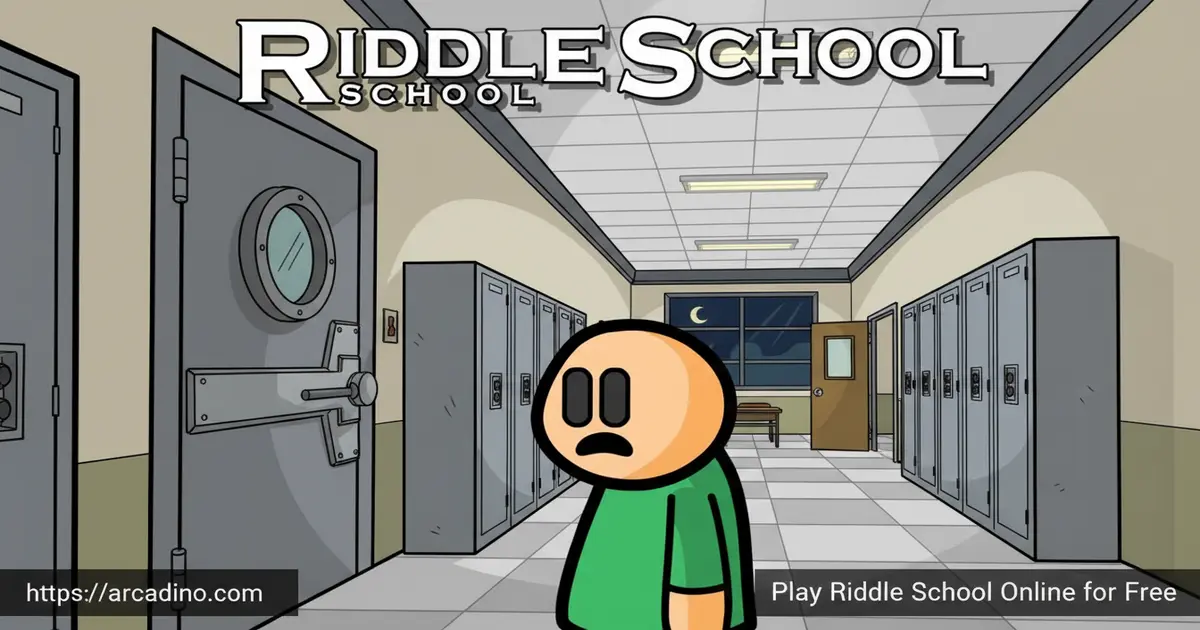
What if escaping school was actually the goal? Riddle School makes that dream real — and you can play it free online right now without downloading a thing. Created by Jonochrome back in 2006, this point-and-click puzzle game puts you in the shoes of Phil Eggtree, a student desperate to break out of his boring classroom. It’s a surprisingly clever little mystery that launched an entire series of escape adventures. If you’ve ever searched for riddle school online, this is the original that started it all.
- Classic point-and-click escape gameplay — interact with objects and outsmart teachers to get out
- Play as Phil Eggtree — the unforgettable student hero of Riddle Elementary School
- First in a beloved series — Riddle School 2 dropped just months after this one
- Free to play in your browser — works on desktop, mobile, and tablet
What Is Riddle School?
Riddle School is a point-and-click escape game created by Jonochrome, who was known as JonBro when the game first launched in 2006. You play as Phil Eggtree, a student at Riddle Elementary who is absolutely done with sitting through a boring lesson. The whole game is about using your wits to trick teachers, interact with objects, and find a way out of the school. It’s the first entry in the Riddle School series, and it set the tone for everything that followed.
The game runs smoothly in a browser window, and the simple cartoon visuals load quickly — the interface feels snappy even on older machines. The point-and-click controls are easy to pick up, so younger players can jump straight into the puzzle-solving without any frustrating learning curve. What makes this title stand out from generic escape games is its personality — Phil’s world has real character, from the oddly small student body of seven kids to the quirky teachers blocking your path. It’s short but genuinely charming, and it rewards players who pay close attention to every clickable detail.
Meet the Creator: Jonochrome’s Story
Jonochrome was just a teenager when he built the very first Riddle School back in 2006 — and he did every part of it himself. The art, the code, the puzzles, the story: all solo. He went by the name JonBro at the time, and the Riddle School games made him well known in the Flash gaming community. Over the years he also created Flipnote animations and other small projects, building a dedicated fanbase well beyond the escape-game crowd. The switch from JonBro to Jonochrome happened as he gradually stepped back from the Riddle School universe and moved toward new creative directions — it marked a real turning point in his identity as an artist. Knowing that a single teenager built this entire five-part series from scratch makes it even more impressive. His voice is all over these games, and that personal touch is a big part of why people still play them today.
Riddle School Gameplay — Clicking, Thinking, Escaping
The core loop of Riddle School is all about exploration and clever thinking. You click on objects around the classroom and hallway, collecting items and figuring out how to use them to progress. Phil’s escape plan unfolds step by step — for example, he pretends to sharpen his pencil just to get out of the classroom in the first place. Every action you take builds toward the bigger goal of sneaking out of Riddle Elementary for good. 😄
The puzzle design is tight and logical, which means solutions feel satisfying rather than random. You’ll need to interact with characters too — confusing and deceiving the teachers is part of the fun. The game doesn’t hold your hand, but it’s fair enough that patient players will always find the answer by exploring every screen carefully. That balance between challenge and accessibility is a big reason this title built such a loyal fanbase.
Riddle School Walkthrough — Phil’s Escape Step by Step
⚠️ Spoiler Warning: This section walks through Phil’s full escape. Skip it if you want to solve the puzzles yourself first!
Phil starts in Mr. Soggy’s classroom and can’t just walk out — he needs a reason to leave. Click on your pencil to use it, then ask Mr. Soggy if you can sharpen it. He’ll say yes, which gets Phil into the hallway. Once you’re out, head to the restroom and grab the coin from inside one of the stalls. Next, find the vending machine in the hallway and use the coin to buy a bag of chips. Take the chips to the teacher on hall duty — she’s distracted by food and steps aside. With her out of the way, Phil can access the area near the front of the school. Grab the bathroom pass hanging on the wall, use it to slip past the final obstacle, and click the front door to finish the escape. The whole sequence is short, but every step requires using the right item in the right place — so if you’re stuck, check your inventory and try each item on every nearby hotspot.
Levels and Progression in Riddle School
Riddle School is a single connected escape adventure rather than a traditional level-based game. You move through different areas of Riddle Elementary — the classroom, the hallway, and beyond — as you collect items and solve each puzzle in sequence. Progress feels natural because each solution opens up the next part of the school for you to explore. There’s a satisfying sense of momentum as Phil’s escape plan comes together piece by piece.
Because the game flows as one continuous experience, you’re always working toward the same goal: getting Phil out the front door. The puzzles are layered so that earlier actions affect what’s possible later on — this means going back to re-examine something you already clicked on is often the key to breaking through a tough spot. Completing the escape unlocks the full story, and the ending even connects directly to the events of Riddle School 5, adding surprising depth to this humble little game.
The specific lore connection involves a character named Diz — an alien villain whose plan to abduct Phil is set into motion on the exact same day Phil makes his escape from Riddle Elementary. In Riddle School 5, it’s revealed that the events of the very first game weren’t just a fun school-skipping adventure: they were the starting point of a much bigger extraterrestrial storyline. Diz had been watching Phil, and Phil’s escape unknowingly triggered the chain of events that the later sequels build toward. It’s a clever retcon that rewards players who go back and replay the original with fresh eyes.
Graphics and Story Personality
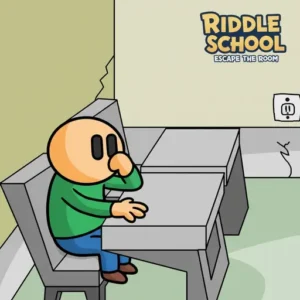
The visuals in Riddle School are simple cartoon-style illustrations that suit the game’s playful tone perfectly. Jonochrome gave each character just enough personality to make them memorable — Phil’s deadpan determination and the teachers’ oblivious attitudes are quietly funny throughout. The school itself has little details worth noticing, like the fact that Riddle Elementary has lockers for dozens of students despite only seven kids actually attending. Those small worldbuilding touches make the setting feel alive and a little absurd in the best way.
There’s no complex audio system or cutscene production here, but the storytelling works because it’s efficient. Every visual clue in the environment serves a purpose, and the game trusts you to piece the narrative together through your own exploration. It’s a great example of how a creative idea can shine even with limited resources — the charm comes from Jonochrome’s imagination, not from technical flashiness.
Legacy Version: What Changed from the Original Flash Release
The original Riddle School was built in Adobe Flash, which meant it ran natively in browsers right up until Adobe officially shut Flash down in December 2020. After that, the game became unplayable for most people without a workaround — which is why the version available today on arcadino.com has been updated to run without Flash entirely. The core gameplay, puzzles, and visuals remain true to Jonochrome’s original design, so you’re still getting the authentic 2006 experience. The main practical difference is under the hood: instead of relying on the old Flash plugin, the game now runs through an HTML5-compatible layer, which actually means faster loading and no browser security warnings. Some players who remember the original may notice very minor differences in how animations render, but nothing that changes the puzzles or the story. If you’ve been searching for how to play Riddle School without Flash, this is your answer — no plugin, no emulator to install, just click and play.
How to Play Riddle School
Getting started is immediate — just open the game in your browser on arcadino.com and you’re dropped straight into Phil’s classroom. There’s no tutorial screen to sit through, which means you start exploring right away. Take your time clicking on everything in the room — objects, characters, and even background details can all be interacted with. Your collected items will be key to solving each puzzle and pushing Phil one step closer to freedom.
The game rewards curiosity above all else. If you’re stuck, try going back to areas you’ve already visited and clicking on things you might have overlooked. The solution is always within reach — you just need to think like a kid who really, really doesn’t want to be in class.
Riddle School Controls
Controls in Riddle School are about as simple as they get. Use your left mouse button to click on objects, characters, and hotspots throughout the school. There’s no keyboard input needed — the entire game is driven by pointing and clicking. On mobile or tablet, tap the screen to interact with everything in the same way, as long as your browser supports the HTML5 version hosted on arcadino.com.
Tips and Tricks for Riddle School
- Click everything, even twice: Some objects in Riddle Elementary only react after you’ve interacted with other items first — revisiting spots you’ve already clicked often reveals new options.
- Talk to characters before you act: The students and teachers in the hallway sometimes give away hints about what Phil needs to do next, so don’t skip dialogue.
- Think about the pencil sharpener early: Phil’s first step out of the classroom involves a simple excuse — understanding why that works will help you spot similar tricks later in the school.
- Check your collected items regularly: Items in your inventory interact with specific hotspots — if you’re stuck, scroll through what you’re carrying and try applying each one to nearby objects.
- Don’t rush the hallway: The school hallway has more going on than it first appears — slow down and click on every corner before moving on to the next area.
Key Features of Riddle School
- Original point-and-click escape mechanics: The entire game is controlled with a single mouse click, making it instantly accessible for players of all ages.
- Phil Eggtree’s school escape story: Play through a fully realized narrative with a specific cast of characters, including the seven students of Riddle Elementary.
- Created by Jonochrome: A solo-developed passion project that grew into a multi-entry series, giving the game a distinct personal voice.
- Series-launching storyline: The events of this game directly connect to later entries, including Riddle School 5, making it essential context for the full series.
- Browser-based and free to play: Runs instantly on desktop, mobile, and tablet with no account or payment required.
Where to Play Riddle School
You can play Riddle School free in your browser right on arcadino.com — no download, no account, and no waiting around. The game works on desktop computers, laptops, mobile phones, and tablets, provided your browser supports the HTML5-compatible version hosted on the site. It loads fast and runs cleanly across all those platforms, so you can pick it up wherever you happen to be.
Playing Riddle School After Flash — How It Works Today
Because Riddle School was originally a Flash game, a lot of players worry it simply won’t run anymore — and that concern is totally understandable. Adobe Flash reached its official end-of-life in December 2020, and major browsers like Chrome, Firefox, and Edge all removed Flash support entirely. The good news is that the version of Riddle School on arcadino.com doesn’t need Flash at all. It’s been preserved in a format that runs directly in modern browsers using HTML5-compatible technology, similar to what open-source tools like Ruffle do for classic Flash content. You don’t need to install any plugin, download any emulator, or change any browser settings — just open the page and the game loads. The gameplay, visuals, and puzzles are all intact, so this is the real Riddle School experience, just without the old plugin holding you back.
For Parents
Riddle School is a gentle point-and-click puzzle game with no violence, no chat features, and no in-app purchases to worry about. The story is built around a student trying to escape a boring classroom, which is lighthearted and easy for kids aged 8 and up to enjoy. It’s worth knowing that later games in the series — particularly Riddle School 4 — do introduce mild blood references and some potentially scary imagery, so parental guidance is useful if your child wants to explore beyond the first game. The original title here is the most straightforwardly kid-friendly entry in the series.
Because this is a relatively short experience, a single play session typically runs between 15 and 30 minutes — a natural stopping point that works well for younger players. The puzzle-solving element encourages logical thinking and patience, as kids need to observe their environment carefully and make connections between items and problems. There’s no time pressure and no fail state, which keeps the experience relaxed and focused on exploration rather than frustration.
Educational Value: What Kids Actually Learn Playing Riddle School
Riddle School is more than just a fun escape — it quietly builds real thinking skills while kids play. The core puzzle loop trains sequential reasoning: players have to figure out which action comes first, second, and third before a solution unlocks. Using collected items on the right hotspots develops inventory management thinking, which is basically the same skill as organising information to solve a real-world problem. Noticing small environmental details — like a coin tucked in an unexpected spot — practises contextual inference, the ability to read a situation and draw conclusions from what you observe. Because there’s no fail state and no timer, kids can take their time and think things through without pressure, making this a genuinely low-stakes way to build logical deduction habits. Teachers looking for a short browser-based brain-break activity will find Riddle School fits neatly into a 15–30 minute window and requires no accounts or setup. It’s a surprisingly strong match for classroom use with students aged 8 to 12.
Similar Games to Riddle School
If Phil Eggtree’s escape got you hooked on point-and-click puzzle adventures, these titles in the same series and genre are worth exploring next.
- Riddle School 2 — The direct sequel to the original, released just months later in November 2006, continuing Phil Eggtree’s escape adventures with new puzzles and locations.
- Riddle School 3 — Another chapter in Jonochrome’s series, expanding the story and introducing more complex point-and-click challenges for fans of the original.
- Riddle School 4 — A later entry in the series that raises the stakes with a more dramatic storyline, though parents should note it contains mild content not present in the first game.
- Riddle School 5 — The fifth installment, which actually ties back directly to the events of the very first game in a surprising story payoff.
Browse more puzzle and escape adventures in the Adventure category.
FAQs About Riddle School
Is Riddle School kid friendly?
Yes, the original Riddle School is appropriate for most kids aged 8 and up. The game contains no violence, scary imagery, or mature themes. However, later entries in the series — especially Riddle School 4 — include mild blood references and some unsettling character designs, so it’s worth checking each sequel individually before younger children play them.
Who created Riddle School?
Riddle School was created by Jonochrome, who was known as JonBro at the time. The game was originally released in 2006 as a Flash-based browser game. Jonochrome went on to develop multiple sequels, turning this single escape puzzle into a full series. He was a teenager when he built the original entirely by himself, and the name change from JonBro to Jonochrome came later as he stepped away from the Riddle School universe and moved toward new creative projects.
Who is the main character in Riddle School?
The main character is Phil Eggtree, a student at Riddle Elementary School. Phil is tired of sitting through boring lessons and decides to escape — which is the entire premise of the game. His personality and the quirky world around him are a big part of what makes the series charming.
How many games are in the Riddle School series?
There are five numbered games in the main Riddle School series, running from Riddle School 1 through Riddle School 5. Jonochrome also created two additional entries — Riddle Transfer and Riddle Transfer 2 — which continue the story of Phil and Diz beyond the original series. That brings the total to seven connected games in the broader Riddle School universe. Riddle School 2 was released just a couple of months after the original, in November 2006, and the series continued from there through Riddle School 5, which connects back to the events of the very first game in a meaningful way.
Who is Diz in Riddle School?
Diz is the alien villain whose plan forms the backbone of the later Riddle School games. In Riddle School 5, it’s revealed that Diz had been targeting Phil all along — and that the day Phil escaped from Riddle Elementary in the very first game was the same day Diz set his abduction plan into motion. This means Phil’s simple classroom escape unknowingly kicked off a much bigger sci-fi storyline. It’s a twist that makes replaying the original feel completely different once you know what’s really going on behind the scenes.
Is Riddle School free to play online?
Yes, Riddle School is completely free to play in your browser. You can access it on arcadino.com without creating an account or paying anything. The version hosted there runs without Adobe Flash, so it works in modern browsers on desktop, mobile, and tablet devices.
How do you control Riddle School?
Use your left mouse button to click on objects, characters, and interactive spots throughout the school. On a touchscreen device, tap the screen to interact with everything in the same way. There are no keyboard controls required — the entire game is point-and-click.
Does Riddle School have multiple endings?
Riddle School leads to a single ending — Phil’s escape from Riddle Elementary. The outcome of that escape is later revealed to have major consequences in Riddle School 5, making the ending more significant than it first appears. The linear structure keeps the experience focused and satisfying for first-time players.
Start Phil’s Escape Today
Riddle School is a tight, clever little escape puzzle that holds up remarkably well for a game from 2006. Phil Eggtree’s determination to ditch class, the quirky cast of characters at Riddle Elementary, and Jonochrome’s instinct for satisfying puzzle design all combine into something genuinely worth playing. The fact that this small browser game directly spawned a five-part series — plus two Riddle Transfer spin-offs — says everything about how much personality it packed into a short experience.
Head over to arcadino.com, click your way through Riddle Elementary, and find out what Phil’s great escape is really leading to. Once you’re out, Riddle School 2 is already waiting.
Gameplay Video