












Watch one short ad and play ad-free for 30 minutes.
2048
Gabriele Cirulli
What happens when a simple grid of numbers becomes completely impossible to put down? 2048 answers that question every single time. This free browser puzzle game asks one thing: slide tiles, merge matching numbers, and reach that legendary tile. It sounds straightforward — it really isn’t. The numbers grow fast, the board fills up faster, and suddenly you’re planning three moves ahead without even realizing it. Players from all over the world have lost hours to this sliding tile challenge, and it’s easy to see why.
- Play free instantly — no download needed, right in your browser
- 4×4 grid gameplay — merge matching tiles to double their value
- Arrow keys or WASD — simple controls that work on any keyboard
- Mobile-friendly — swipe to play on phones and tablets too
What Is 2048?
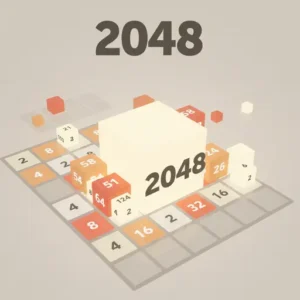
2048 is a single-player sliding tile puzzle game created by Gabriele Cirulli and released in 2014. The goal is to combine numbered tiles on a 4×4 grid until one tile reaches the value of 2048. It’s an open-source game that became a global sensation almost overnight. Millions of players still return to it regularly, which says everything about how well the core idea holds up.
The grid starts with just two tiles — each showing either a 2 or a 4. Every move you make shifts all tiles in one direction at once. That simple rule creates an enormous amount of strategic depth. The moment you realize you can’t just slide randomly, the real game begins. 😎
Playing it in the browser on Arcadino, the controls respond instantly — there’s no lag between pressing an arrow key and watching the tiles glide across the grid. The clean visual layout makes it easy to track every number on the board, even when things get crowded near the end of a run.
Gameplay — Merging Your Way to 2048
Every round of 2048 starts the same way: two numbered tiles appear on the board, and you begin sliding. When two tiles carrying the same number collide, they merge into one tile with double the value. A pair of 2s becomes a 4, two 4s become an 8, and the chain continues all the way up through 16, 32, 64, 128, 256, 512, 1024, and finally 2048.
After every move you make, a new tile spawns somewhere on the board. This is where the pressure builds. The board is only 4×4, so space disappears quickly if you’re not thinking ahead. Every slide matters because an unlucky merge in the wrong spot can block your entire strategy. That constant tension between opportunity and risk is what keeps players coming back.
Strategy and Progression
Reaching the 2048 tile isn’t just about merging whatever you can whenever you can. The players who get there consistently use real strategy. The most popular approach is to pick one corner — usually bottom-right — and keep your highest-value tile locked there at all times.
From that anchor, you build a chain along one row or column, arranging tiles from smallest to largest toward the corner. This keeps your big numbers close together and ready to merge. Thinking even two or three moves ahead separates good runs from great ones. A merge that looks helpful right now might trap a high-value tile in an awkward spot just one move later.
The Snake Strategy — An Advanced Alternative
Once you’ve mastered the corner method, try the snake strategy. Instead of a straight chain along one edge, you arrange your tiles in a zigzag pattern — the biggest number sits in one corner, the chain runs along the bottom row, reverses direction on the next row up, then reverses again on the row above that, like a snake winding through the grid. This layout helps when your corner tile can’t move in one direction and the board starts to lock up. The snake pattern keeps more high-value tiles within merging range of each other. It’s harder to maintain than a simple edge chain, but experienced players use it to push past 2048 toward tiles like 4096 or even 8192. Give it a try once the corner strategy feels natural.
Why 2048 Is So Addictive
There’s a reason this puzzle title took off so fast back in 2014 and never really slowed down. The game taps into something satisfying about powers of 2 — each merge feels like a small win, and the bigger the number, the more rewarding that pop of tiles feels. You’re always just one good sequence away from your next milestone.
That near-miss feeling is a real psychological hook called the near-miss effect — your brain treats “almost winning” almost like winning. Each run also gives you a small mastery boost: you notice patterns, improve your chain management, and genuinely get better. The game rewards skill growth without ever making you sit through a tutorial, which makes the improvement feel earned rather than guided.
The game also ends on your terms, or at least it feels that way. When the board fills up and no moves remain, it’s hard not to think “I almost had it.” That almost is what sends players straight back to a new game. It’s a loop that works brilliantly without any extra rewards or unlockables needed.
How to Play 2048
Starting a game of 2048 takes about two seconds. Head to the game page, and the 4×4 grid loads immediately with two starting tiles already in place. Your only job is to slide tiles around the board until you merge your way to the 2048 tile — or until the board fills up completely with no valid moves left.
The game ends when every square is occupied and no two adjacent tiles share the same number. That means no more merges are possible anywhere on the board. Getting to that point without reaching 2048 counts as a loss, but your high score carries over as motivation for the next attempt.
Controls for 2048
On desktop, use the arrow keys or W, A, S, D to slide all tiles in any direction. Every keypress moves the entire board at once — not just one tile. On mobile or tablet, swipe left, right, up, or down to achieve the same effect. The swipe controls feel just as responsive as the keyboard version, which makes this title genuinely comfortable to play on a phone screen.
How the Scoring System Works
Your score goes up every time you merge two tiles. The amount added equals the value of the new merged tile — not just 1 point per merge. So merging two 2s adds 4 to your score. Merging two 64s adds 128. Merging two 512s adds 1,024 in a single move. That’s why two players can both reach the 2048 tile but end up with very different scores — one player merged lots of small tiles early on, while the other saved big merges for later. The big late-game merges are worth far more. For example, if you manage to merge two 1024 tiles to hit 2048, that single merge alone adds 2,048 points. Chasing a high score means thinking about which merges to delay, not just how fast you can reach the goal tile.
Undo — Does 2048 Have One?
The original browser version of 2048 by Gabriele Cirulli does not include an undo button. One wrong swipe and you live with the consequences — that’s part of what makes each move feel so important. However, several popular clones and the official mobile apps do include an undo feature, usually limited to one move back. If you’re playing on the Google Play Store or Apple App Store version, check the interface for an undo option before you start. Having undo available changes how you play: it removes the fear of a single accidental swipe, which lets you experiment more freely with risky moves. Playing without undo — like on the original browser version here — is considered the more challenging and authentic experience by most players.
Tips and Tricks for 2048
- Claim a corner early: Pick one corner for your highest-value tile and never let it leave. Most winning runs use the bottom-right corner as the anchor point.
- Build a chain along one edge: Line up your biggest numbers in descending order along one row or column leading into your corner tile. This makes merges predictable and clean.
- Avoid random merges: Don’t combine tiles just because you can. A careless merge can scatter high-value tiles across the board where they can’t reach each other.
- Think two or three moves ahead: Before each slide, check what the board will look like after the move. A new tile spawns after every turn, so always plan for that extra piece.
- Keep a full row near your anchor: Try to keep the row or column containing your largest tile filled up. This prevents new tiles from spawning in spots that would break your chain.
Key Features of 2048
- Open-source design by Gabriele Cirulli: The original code is freely available, making this one of the most transparent puzzle games ever created.
- Pure powers-of-2 progression: Every merge follows a strict doubling chain — 2, 4, 8, 16, all the way to 2048 and theoretically beyond.
- Single-tap or single-swipe controls: One input moves the entire board, making every decision feel weighty and deliberate.
- Cross-device compatibility: The same game works identically on desktop browsers, iPhones, iPads, and Android devices without any quality loss.
- Endless replayability with a high score target: Each new game challenges you to beat your previous best, giving every run a personal goal to chase.
Other Versions and Variants of 2048
The original 2048 is a 4×4 grid, but players who’ve mastered that have plenty of bigger challenges to explore. A popular variant uses a 5×5 grid, which gives you more space to work with but also lets tiles pile up even higher — the extra room sounds helpful, but it makes it harder to keep your chain organized. There’s also a 4096 mode where the goal tile is doubled, demanding a much longer and more precise run to complete. Themed versions are everywhere too: some swap numbers for letters (spelling out words as you merge), others use emoji, characters from popular games, or Fibonacci sequences instead of powers of 2. These variants all keep the same core swipe-and-merge mechanic, so your skills transfer directly. If the standard game feels too easy — or you just want a fresh twist — searching for “2048 variants” in your browser turns up dozens of fun alternatives to try.
Browser vs. App — Performance and Offline Play
The browser version of 2048 on Arcadino loads fast and runs smoothly even on older computers and budget smartphones. Because it’s a lightweight puzzle with no 3D graphics or heavy animations, it works well even on low-end devices that struggle with other browser games. One underrated perk: the original-style browser version can keep working offline after the first load, similar to a Progressive Web App — so if your internet cuts out mid-game, you won’t lose your run. The browser version also has no ads, asks for no permissions, and uses no storage space on your device, unlike many app store clones that bundle in trackers or upsell premium modes. If you’re deciding between the browser version and an app, the browser version is the cleaner, more private choice for quick sessions — save the apps for when you want offline play with undo support built in.
Where to Play 2048
You can play 2048 for free right here on Arcadino. No account, no installation, and no waiting — the game runs entirely in your browser and loads almost instantly. It works on Chrome, Firefox, Safari, and other modern browsers without any issues.
If you’d rather play on your phone, official mobile versions are available for both major platforms. Grab it from the Google Play Store for Android or the Apple App Store for iPhone and iPad. Stick to these official sources — avoid any APK downloads from random websites, as unofficial files can carry security risks.
For Parents
2048 is a great fit for kids aged 8 and up. There’s no violence, no chat, and no in-app purchases involved in the core browser version. The game quietly builds familiarity with powers of 2 and encourages logical thinking without ever feeling like homework.
Because each game is self-contained and usually lasts between five and fifteen minutes, it’s easy to set natural stopping points. It’s the kind of puzzle activity that exercises planning skills and number sense at the same time — skills that genuinely carry over into math class.
The cognitive benefits go deeper than just numbers. Every session asks kids to recognize patterns — like noticing that their tile chain is about to collapse — which builds the same kind of pattern recognition used in reading and coding. Planning two or three moves ahead develops working memory and forward-thinking, which are core executive function skills. The game also introduces exponential growth in a hands-on way: kids quickly feel why 512 takes so much longer to build than 64, giving them an intuitive understanding of how fast powers of 2 grow. Teachers have used 2048 to open conversations about binary numbers, computer memory, and even financial concepts like compound growth. For parents, it’s a rare screen activity where the fun and the learning genuinely overlap.
Similar Games to 2048
If the sliding tile challenge of 2048 has you hooked on number puzzles, these browser games are worth trying next.
- Threes — The original sliding number puzzle that inspired 2048, with a slightly more forgiving grid and charming tile personalities.
- Sudoku — A classic number-placement puzzle that rewards the same careful, systematic thinking that 2048 demands.
- 1010 — A block-fitting puzzle on a 10×10 grid where managing space is just as critical as it is in 2048.
- 2048 5×5 — A bigger-grid twist on the original where a 5×5 board gives you more room but an even higher tile goal to chase.
Browse more challenges in the Puzzle category on Arcadino.
FAQs About 2048
Who created 2048?
Gabriele Cirulli created 2048 in 2014. He released it as an open-source project, which means the code is freely available for anyone to study or build on. The game became a viral hit within days of launch and is still widely played today.
What is the goal of 2048?
The goal is to get a single tile to reach the number 2048. You do that by sliding tiles across a 4×4 grid and merging pairs of matching numbers. Each merge doubles the value, so you work through 2, 4, 8, 16, and so on until one tile hits 2048.
Is there a trick to winning 2048?
Yes — keep your highest-value tile locked in one corner throughout the game. Build a descending chain of numbers leading into that corner along one row or column. Avoid merging tiles haphazardly across the board, and always try to think two or three moves ahead.
What is the highest number possible in 2048?
The mathematically theoretical maximum tile on a 4×4 grid is 131,072 — but reaching it under standard spawn rules is considered essentially impossible in practice. The enthusiast and speedrunning community generally treats 65,536 as the realistic ceiling for an extraordinary run. Most players celebrate just getting to the 2048 tile itself, and anything beyond that is a serious achievement.
Is 2048 a math game?
Yes, 2048 is built entirely around powers of 2. Every tile value is a number from that sequence — 2, 4, 8, 16, 32, and so on. Playing it gives you a natural feel for how quickly these numbers grow, which connects directly to concepts taught in school math.
Can I play 2048 on my phone?
Yes, 2048 works on phones and tablets through the browser or official apps. You swipe in any direction to move all tiles at once. The game is available on the Google Play Store for Android and the Apple App Store for iPhone and iPad.
What happens when the board fills up in 2048?
The game ends when no empty squares remain and no two adjacent tiles match. At that point, no merges are possible and the run is over. Your final score is recorded so you can try to beat it on the next attempt.
Conclusion
Few browser puzzles have stuck around as long as 2048 — and for good reason. The doubling chain from 2 all the way to 2048, the constant pressure of a filling board, and the deeply satisfying crunch of a perfect merge make every session feel earned. It’s a puzzle that genuinely rewards thinking ahead, and that feeling of growing strategy is rare in free browser games.
Whether you’re chasing a personal best or trying to clear that final merge for the first time, this tile puzzle has a way of pulling you back in. Fire up a new game on Arcadino and see how far your grid strategy can take you.
Gameplay Video