


























Watch one short ad and play ad-free for 30 minutes.
Yukon Solitaire
Various (public domain)If you’ve already crushed regular Solitaire and want a real brain workout, Yukon Solitaire is waiting for you. It’s a free browser card game that takes the classic Klondike setup and cranks the difficulty way up. The big twist? There’s no stockpile to bail you out, and you can move messy stacks of cards even when they’re not in order. It’s often just called “Solitaire” by players who don’t know the variant name, but trust us, this one hits different. 🃏
Every card is dealt at the start, so the whole puzzle stares you in the face from move one. That makes Yukon Solitaire feel less like luck and more like a logic challenge you can actually plan around.
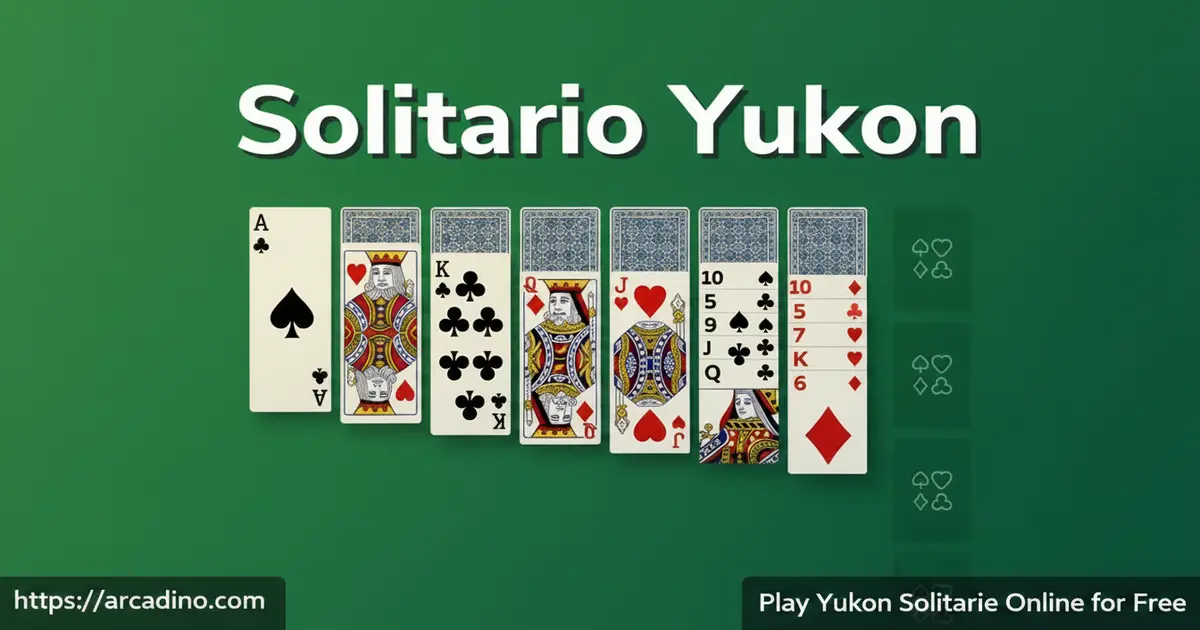
- All 52 cards dealt at once across 7 tableau columns
- No stock or waste pile – every move counts
- Move grouped cards even if they’re out of order
- Free to play in any modern browser, no download
What Is Yukon Solitaire?
Yukon Solitaire is a one-deck card game in the half-open packer family. Your job is to build four foundation piles from Ace to King, one for each suit. It looks like Klondike at first glance, but the rules around moving cards are totally different. That single change makes it one of the trickiest Solitaire variants around.
- Game family: Half-open packer Solitaire
- Deck: One standard 52-card deck
- Players: Single player
- Goal: Build four foundations, Ace to King, by suit
Loading the game in a browser is instant for me – no install screen, no sign-up wall, just the green felt and dealt cards. The drag-and-drop feels responsive on both desktop and touchscreens. If you’ve ever played Klondike on a school Chromebook, this runs just as smoothly.
A Quick Origin Story
Yukon Solitaire is named after the Yukon, a wild region in northwestern Canada, just like its cousin Klondike. Both games trace back to the early 20th century and the Gold Rush era, when miners passed cold nights shuffling decks. The Yukon variant grew popular as a tougher spin-off once players wanted Klondike with more bite. Today it’s a staple in nearly every browser Solitaire collection.
Yukon Solitaire Gameplay
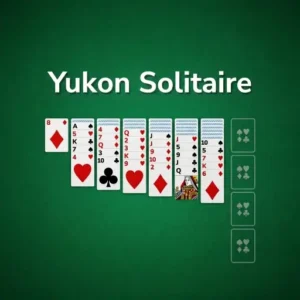
The tableau has seven columns. The first column holds a single face-up card, and each column after that adds one more face-down card plus five face-up cards on top. So column 7 is the chunky one with the most hidden cards to dig through.
You build columns down in alternating colors – a red 6 on a black 7, then a black 5 on the red 6, and so on. Here’s the magic move: you can grab a card from anywhere in a column and drag it along with every card sitting on top, even if those cards are total chaos. As long as the card you’re moving lands on something one rank higher and the opposite color, it’s a legal move.
Empty columns can only be filled with a King, or a King with a group of cards attached. Face-down cards flip automatically when revealed. The game ends when every card sits on the foundations in suit order from Ace to King.
What Makes Yukon Solitaire Harder Than Klondike
In Klondike, you only move cards from the tableau if they’re already in a tidy sequence. Yukon throws that rule in the trash. You can yank any face-up card with its messy pile of followers wherever you want, as long as the bottom card of the group fits the color-and-rank rule.
That sounds easier, but it isn’t. There’s no stockpile to flip through when you get stuck, so every move locks in or unlocks future moves. Reported win rates vary – some sites cite around 12-13%, while one tracker of over 600,000 games logged 13.69%. A few generous versions claim much higher numbers, so treat any single figure as a rough guide, not a rule.
Strategy Layers in Yukon Solitaire
Because every card is visible from the start (except the face-down ones), Yukon rewards players who pause and read the board. You can see which Aces are buried where, and you can usually trace a path to dig them out. That planning step is what separates a 5-minute defeat from a satisfying win.
The deeper you play, the more you start seeing chains of moves three or four steps ahead. It’s chess vibes wrapped in card-game clothing.
A Worked Example of a Super Move
Let’s walk through a real cascade so the group-move rule clicks. Imagine column 3 looks like this from top to bottom: black King, red 9, black 2. Column 5 has an exposed black 10, and column 1 is empty after you cleared it earlier. Step one: grab the black King along with the red 9 and black 2 sitting on top, and drop the whole stack into the empty column 1. Step two: now the red 9 (with the black 2 still tagging along) can slide onto the black 10 in column 5. Step three: park the black 2 on any red 3, or send it up if its Ace is already on the foundation. In three moves you’ve untangled a messy column and exposed a fresh face-down card. That’s the Yukon magic in action.
How to Play Yukon Solitaire
Getting started takes about ten seconds. Open the game in your browser, wait for the cards to deal, and look for an Ace or a card you can move to start a chain. Your first goal is almost always to free up an Ace so you can begin a foundation pile. After that, focus on uncovering face-down cards.
You win by sending every card to the foundations in suit, Ace through King. Most versions track your time and number of moves, so you can race your own best score.
Controls for Yukon Solitaire
On desktop, click and drag a card (or a stack starting from any card) to move it. A double-click usually sends a card straight to its foundation if it has a legal home. Right-click or use the undo button to take back a move. On phones and tablets, tap-and-drag works the same way, and tap-to-place is supported in most versions.
Pulling Cards Back From the Foundation
Here’s a feature lots of players miss: many Yukon Solitaire versions let you drag a card from the foundation back down to the tableau. That’s a real lifesaver when you’ve sent up a low card too early and now need it to park another card on. For example, if you rushed a red 2 to the foundation but really needed it to land a black Ace’s neighbor, you can pull the 2 back. Use this trick sparingly, but know it’s there before you panic.
Accessibility and School Chromebook Performance
Yukon Solitaire is one of the lightest browser games around, so it runs at a smooth frame rate even on older Chromebooks and budget tablets. There’s no heavy graphics engine – just cards, a green table, and clean animations. Most versions support keyboard shortcuts: Ctrl+Z for undo, F2 or N for a new game, and arrow keys for navigation in some builds. For players who are color-blind, the alternating-color rule (red on black) can be tricky, so look for versions that offer a four-color deck where suits get unique shades like blue clubs and green diamonds. Larger card themes and high-contrast modes are common in the better browser editions too. These small touches make the game friendly for classrooms and shared family devices.
Tips and Tricks for Yukon Solitaire
- Free your Aces fast. Foundations can’t start without them, so dig out buried Aces before doing anything fancy.
- Empty the short columns first. Column 1 has just one card, so clearing it gives you a King-ready slot quickly.
- Move messy groups on purpose. Use the “move any face-up card with everything on top” rule to expose face-down cards in deep columns.
- Build foundations in pairs. If both black 3s go up without the red 2s ready, you can lose useful tableau anchors.
- Don’t auto-send everything. Sometimes keeping a low card in the tableau helps you park other cards on it. Patience wins Yukon games.
When NOT to Send a Card to the Foundation
This is the move that breaks more Yukon games than any other. Here’s a simple heuristic to follow before you send a low card up. First, ask: are both opposite-color cards one rank lower already on the foundation? If yes, send it up – it’s safe. For example, only send a black 4 up once both red 3s (hearts and diamonds) are already on their piles, or are sitting at the bottom of the foundation and won’t be needed. Why? Because a stranded red 2 with no black 3 in the tableau means you can’t park that 2 anywhere useful. The tableau loses a key anchor, and any black Ace you free up later has nowhere to chain from. The flowchart looks like this: low card ready? -> check both opposite-color cards one rank lower -> both safe? send up. One still needed? Hold it. Follow this and you’ll dodge dead-end boards way more often.
Key Features of Yukon Solitaire
- Classic 52-card deck dealt fully at the start – no hidden stock
- Group-move rule that lets you shift jumbled stacks freely
- Move counter and timer to chase personal bests
- Undo and hint options in most browser versions
- Works on desktop, tablet, and phone in landscape or portrait
Where to Play Yukon Solitaire
The easiest way to play is right in your browser – load the page, the cards deal, and you’re in. It’s free, runs on Chrome, Firefox, Safari, and Edge, and doesn’t ask you to register. Yukon Solitaire also plays well on Chromebooks, which is why a lot of players first find it through school-friendly card game sites.
Prefer mobile? Grab the official app on Google Play or the App Store. Stick to official stores – sketchy APK downloads aren’t worth the risk for a card game that runs perfectly in your browser anyway.
For Parents
Yukon Solitaire is a great quiet-time game for kids around 8 and up who can read card ranks and plan a few moves ahead. There’s no chat, no multiplayer, and no in-game purchases needed for browser play. It encourages logical thinking, patience, and pattern recognition – skills that may also support focus during schoolwork.
Sessions tend to be short, usually 5 to 15 minutes per game, which makes it easy to set healthy time limits. It’s a solid screen-time alternative to fast, flashy action games.
Similar Games to Yukon Solitaire
If Yukon hooks you, these card games scratch the same strategic itch:
- Klondike Solitaire – the classic Solitaire most players grew up with, easier than Yukon thanks to the stockpile.
- Spider Solitaire – another tough variant using two decks and suit-based building.
- FreeCell – logic-heavy Solitaire with four free cells and almost every game winnable.
- Scorpion Solitaire – a close cousin to Yukon with similar group-move rules.
- Russian Solitaire – basically Yukon but you build by same suit, making it brutally hard.
- Alaska Solitaire – a Yukon variant where you can build down by alternating colors or up by same suit, mixing two strategies in one.
- Canfield Solitaire – a fast, stock-based Solitaire that’s great for practicing planning skills between Yukon sessions.
Browse more in Card Games for the full collection.
FAQs About Yukon Solitaire
How do you play Yukon Solitaire?
You move cards between seven tableau columns to build four foundation piles from Ace to King by suit. Columns are built down in alternating colors. The unique part is that you can move any face-up card along with everything stacked on top, even if those cards aren’t in order.
Is Yukon Solitaire always winnable?
No, not every Yukon Solitaire deal can be won. Reported win rates land around 12-14% across most trackers, though that climbs with practice and careful play. Some deals lock you out no matter how smart your moves are.
Is Yukon Solitaire the same as regular Solitaire?
No, regular Solitaire usually means Klondike, which has a stockpile and stricter movement rules. Yukon deals all cards at the start and lets you move messy groups freely. Both share the Ace-to-King foundation goal.
Can you win Yukon Solitaire every time?
No, even expert players lose plenty of games. The lack of a stockpile means one bad early move can dead-end the whole board. Use undo wisely and plan several moves ahead to boost your odds.
Is Yukon Solitaire harder than Klondike?
Yes, Yukon is widely considered harder than Klondike. There’s no stock or waste pile to recycle through, so you only get one shot at each layout. The flexible group-move rule helps a little but doesn’t make up for it.
Do I need to download anything to play Yukon Solitaire?
No download is needed for browser play. Just open the page and the game loads. Mobile apps are optional if you want offline play on your phone.
What’s the best opening move in Yukon Solitaire?
Look for an Ace you can free up or a face-down card you can expose. Starting a foundation early and clearing column 1 for a King are usually the strongest first moves. Avoid burning the undo button on impulse plays.
Ready to Shuffle Up?
Yukon Solitaire packs the visual familiarity of classic card play with a meaner, more cerebral ruleset that keeps players coming back. The all-cards-visible deal, the group-move freedom, and the missing stockpile combine into a puzzle that’s quick to learn and tough to master. Whether you win in five minutes or fight a single deal for half an hour, every round teaches you something new about reading the board. Deal a fresh game and see how many Aces you can rescue before the board freezes.
Gameplay Video