











Watch one short ad and play ad-free for 30 minutes.
Checkers
RedFocFew board games hit that sweet spot between simple rules and deep strategy like Checkers. You can learn the basics in two minutes, but mastering double jumps, blockades, and King traps takes way longer. The good news? You can play Checkers online for free right in your browser, with no sign-up and no download needed. Pick your difficulty, grab the black or red pieces, and start hunting your opponent’s discs.
This classic also goes by Draughts in some parts of the world, and versions of it date back thousands of years. That long history is part of why it still feels fresh today. 🎯
- Play solo against the computer or pass-and-play with a friend
- Multiple difficulty levels for beginners through experienced players
- Crown your discs into Kings that move forward and backward
- Optional Force Jump rule for tournament-style matches
What Is Checkers?
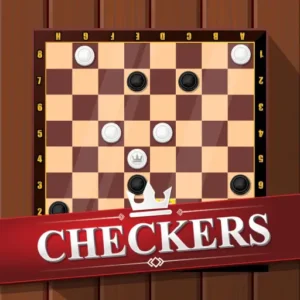
Checkers is a two-player strategy board game played on an 8×8 grid of alternating dark and light squares. Each side starts with 12 small round discs placed on the dark squares closest to them. One player takes black, the other takes red, and the goal is simple. Capture all your opponent’s pieces or trap them so they can’t move.
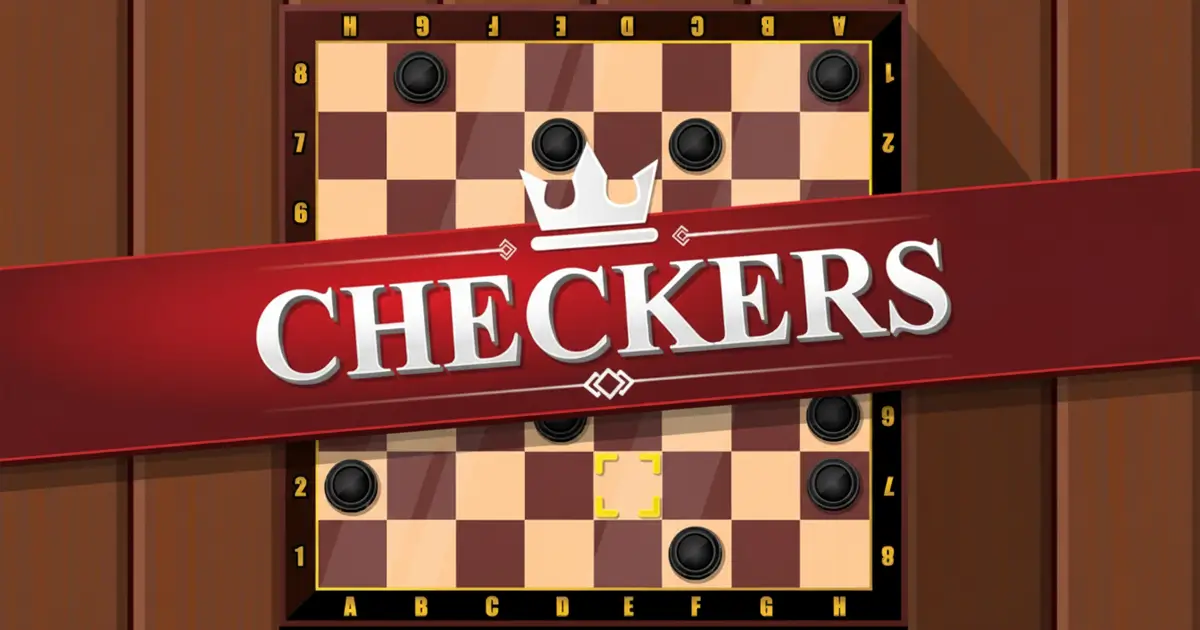
Some versions also offer larger 10×10 or 12×12 boards for a longer match. The browser version loads almost instantly, and the click-to-move controls feel snappy even on older laptops. I really like how the highlighted yellow square shows exactly where your piece will land before you commit. That little touch makes Checkers way friendlier for first-timers.
Gameplay in Checkers
Every disc moves the same way: one square diagonally forward onto a dark tile. You can never land on a light square, and you can’t move onto a square that’s already occupied. Players take turns, and black usually goes first. The whole match is a slow squeeze where you push your line forward while protecting your back row.
Capturing happens when you jump diagonally over an opponent’s piece into an empty square behind it. That captured disc gets removed from the board. If your piece lands somewhere that lets it jump again, you keep going, chaining double or triple jumps in a single turn. Those combo captures are the most satisfying moments in any Checkers game.
Draws and Stalemates in Checkers
Not every match ends with a knockout. A game is called a draw if both sides repeat the same position three times in a row. Most rule sets also use a 50-move rule, meaning if 50 moves pass with no capture or promotion, it’s a tie. A lone King versus a lone King almost always counts as a draw too, since neither side can force a win. The browser version usually tracks these counters for you, so you’ll see the draw offer pop up automatically.
Kings and Promotion in Checkers
When one of your discs reaches the far row on your opponent’s side, it gets promoted into a King. Kings are the heavy hitters of the board because they can move and jump diagonally in both directions. A single well-placed King can wipe out an entire chunk of enemy pieces if you set up the angles right. The player with more Kings usually wins, so racing to crown your first one is a huge early-game goal.
If you become a King mid-jump, you have to stop there. You can’t immediately jump backward on the same turn, so you’ll need to wait for the next move to fully unleash your new King.
Game Modes in Checkers
The browser version of Checkers usually offers a few ways to play. Single-player mode pits you against a computer opponent across four difficulty levels, from Easy to Expert. Two-player pass-and-play lets you share one device with a friend, taking turns making moves. Some versions also include daily challenges or online matchmaking against a real opponent somewhere else in the world.
You can often tweak the rules before starting a match. The Force Jump option, for example, requires you to capture whenever a jump is available. Toggle it on for stricter tournament-style play, or leave it off for a more relaxed game.
Why Players Love Checkers
Checkers has a surprising amount of depth packed under its simple rules. There are roughly 500 billion billion legal positions, which is why the game stayed interesting for so long. In 2007, a project called Chinook even mathematically solved Checkers, proving that perfect play by both sides ends in a draw. That’s wild news for a game you can learn in two minutes. Matches still stay short and fun, so you can squeeze one in between classes or homework without losing the thread.
Did a Computer Really Solve Checkers?
Yes, and it’s one of the coolest facts in board game history. A team at the University of Alberta spent almost 18 years building Chinook, a program that analyzed every meaningful Checkers position. In 2007 they announced the game was “weakly solved,” meaning if both players make perfect moves, the result is always a draw. That’s why the highest computer difficulty levels in browser Checkers feel almost impossible to beat. They’re drawing on decades of research baked into the engine. The good news? Lower difficulty levels make small mistakes on purpose so you can actually win. Chess, by comparison, has way too many positions to ever fully solve, which is part of why Checkers and Chess feel so different to study.
How to Play Checkers
Getting started is easy. Open the game in your browser, click Play, and choose 1 Player or 2 Player. Pick your difficulty if you’re going solo, then select whether you want black or red discs. Black moves first, so grab those if you like jumping into action right away.
Controls for Checkers
On desktop, click one of your pieces to select it, then click the dark square you want to move to. Invalid squares simply won’t accept the move. On mobile, tap a piece to highlight it, then tap your destination tile. Most versions also include a Show Moves toggle that lights up every legal move for the selected disc, which is super helpful while you’re learning.
Tips and Tricks for Checkers
- Don’t hug the sides. Edge pieces feel safe but lose mobility, while center discs control more of the board.
- Keep your back row intact early on. A full home row stops your opponent from sneaking pieces in to crown.
- Race to the King row. The player with more Kings almost always wins, so push promotion candidates fast.
- Look for double and triple jumps every turn. Chained captures swing the score hard in your favor.
- Trade pieces when you’re ahead. Swapping one of yours for one of theirs simplifies the board and protects your lead.
- Set up blockades to trap your opponent. Line your pieces so theirs have no legal diagonal move, and you win even without capturing them all. Corners and edges are the easiest spots to build a squeeze.
Key Features of Checkers
- Multiple computer difficulty levels so the game scales with your skill
- Pass-and-play two-player mode on the same device
- Optional larger boards (10×10 or 12×12) for longer, deeper matches
- Show Moves, Hint, and Undo helpers built right in
- Automatic save so you can return to an unfinished match later
Where to Play Checkers
The fastest way to play Checkers is right in your browser. Load the page, pick a difficulty, and you’re playing within seconds. There’s no install, no account creation, and no waiting on updates. It also runs fine on school Chromebooks and older laptops because the game is light on resources.
If you want Checkers on the go, there are official mobile apps too. Grab it on Android via the Google Play Store or on iPhone and iPad via the App Store. Stick to those official stores rather than random APK downloads, since unofficial files can carry malware. The browser version remains the easiest pick for quick matches at home or between school assignments.
Accessibility and Low-Spec Play
Browser Checkers is built to run almost anywhere. After the first load, most versions work offline, so a wobbly Wi-Fi signal won’t ruin your match. The game runs smoothly on Chromebooks and laptops with just 4GB of RAM, and it doesn’t drain a tablet’s battery. Controls stay simple click-or-tap, which is friendly for kids still learning a trackpad. There’s no strobing or flashing animation, which makes it safer for players sensitive to bright effects. The clean, high-contrast board also helps if you’re playing on a small screen or in bright sunlight.
For Parents
Checkers is a great fit for kids ages 6 and up. The rules are easy to teach, and the game quietly builds spatial awareness, planning, and problem-solving skills. There’s no chat with strangers in the standard single-player or pass-and-play modes, and there’s nothing violent or scary on screen. Short matches usually run 5 to 15 minutes, which makes Checkers ideal for a quick break rather than a long sit-down session.
Skills Checkers Builds in the Classroom
Each rule in Checkers quietly trains a different brain skill, which makes it a sneaky-good learning tool. The Force Jump rule teaches consequence evaluation, since one required capture can wreck your whole plan. Racing to crown a King teaches goal prioritization, because you have to balance offense with protecting your back row. The “trade when ahead” tip is basic resource management, the same skill kids use in math word problems. Looking for double jumps trains pattern recognition and several-steps-ahead planning. Even losing a match builds resilience, since you can replay instantly and try a new approach. Teachers often use short Checkers matches as warm-up brain exercises before harder lessons.
Similar Games to Checkers
If you enjoy the slow-burn strategy of Checkers, these classic board and logic games hit the same itch.
- Chess – The deeper, more complex cousin played on the same 8×8 board with unique piece movements.
- Mancala – An ancient seed-sowing game that rewards counting ahead and clever timing.
- Backgammon – A two-player race game mixing dice rolls with sharp tactical choices.
- Chinese Checkers – A star-shaped board variant where you hop pieces across to the opposite point.
- Reversi – Flip your opponent’s discs by trapping them between yours on an 8×8 grid.
Browse more options in our Board Games category.
FAQs About Checkers
Is Checkers free to play online?
Yes, Checkers is completely free to play in your browser. You don’t need an account, a download, or a payment method. Just open the page, pick your settings, and start a match. Mobile apps may include optional ads or extras, but the browser game stays free.
How do you play Checkers?
Move your discs diagonally one square at a time on the dark tiles. Capture an opponent’s piece by jumping diagonally over it into an empty square behind it. Reach the far row to crown a King, which can move both forward and backward. You win when your opponent has no pieces or no legal moves left.
How many pieces are there in Checkers?
There are 24 pieces total in a standard Checkers game. Each player starts with 12 discs arranged across three rows on the dark squares closest to them. The pieces are usually red and black, though some versions use white and black.
Can you double jump in Checkers?
Yes, double and triple jumps are legal and encouraged. If your piece lands somewhere that allows another capture, it must continue jumping in the same turn. Chaining jumps is one of the fastest ways to swing the game in your favor.
How old is Checkers?
Checkers traces back about 5,000 years to an ancient game called Alquerque, with similar boards even found in Egyptian ruins from around 3000 BC. The modern 8×8 version we play today took shape in Europe roughly 800 years ago. So while the exact rules have changed, the core idea of jumping pieces is genuinely ancient.
Is Checkers the same as Draughts?
Yes, Checkers and Draughts are essentially the same game. Draughts is the common name in British English, while Checkers is used in American English. Some regional variations like International Draughts use bigger boards and slightly different rules.
What are the main Checkers variants?
There are a few popular versions worth knowing. American or English Draughts uses an 8×8 board with 12 pieces per side, and that’s the version most browser games default to. International Draughts is played on a 10×10 board with 20 pieces per side, and Kings (called “flying Kings”) can slide multiple squares at once. Canadian Checkers goes even bigger with a 12×12 board and 30 pieces per side, making matches much longer. Bigger boards mean more pieces, more jumps, and a slower, more strategic pace.
Which is harder, Chess or Checkers?
Chess generally has more variables and a steeper learning curve than Checkers. That said, Checkers still has deep strategy once you start studying jumps, traps, and endgame Kings. They’re different enough that comparing difficulty is a bit like apples and oranges.
What is the best first move in Checkers?
Most strong players push a center pawn forward to claim mobility early. Edge pieces are safer from capture but limit your options later. Building toward the middle of the board sets up better jump opportunities as the game develops.
Ready to Crown Some Kings?
Checkers proves that a 5,000-year-old game can still feel fresh on a modern screen. Between the multiple difficulty levels, the satisfying chain jumps, and the race to crown Kings, every match offers something new. Pick your color, sharpen your strategy, and see if you can clear the board before your opponent does.
Gameplay Video