



























Watch one short ad and play ad-free for 30 minutes.
Mahjong Solitaire
Various (public domain)If you love spotting patterns and planning two moves ahead, Mahjong Solitaire is your kind of puzzle. This free online tile-matcher takes the centuries-old Chinese game and turns it into a calming one-player brain workout. You pair up identical tiles from a stacked pyramid until the whole board is clear. It sounds simple, but every click changes what’s reachable next.
Mahjong Solitaire works right in your browser, so there’s nothing to install before your first match. It’s also great for kids who want a quiet break from fast-paced action games. 🀄
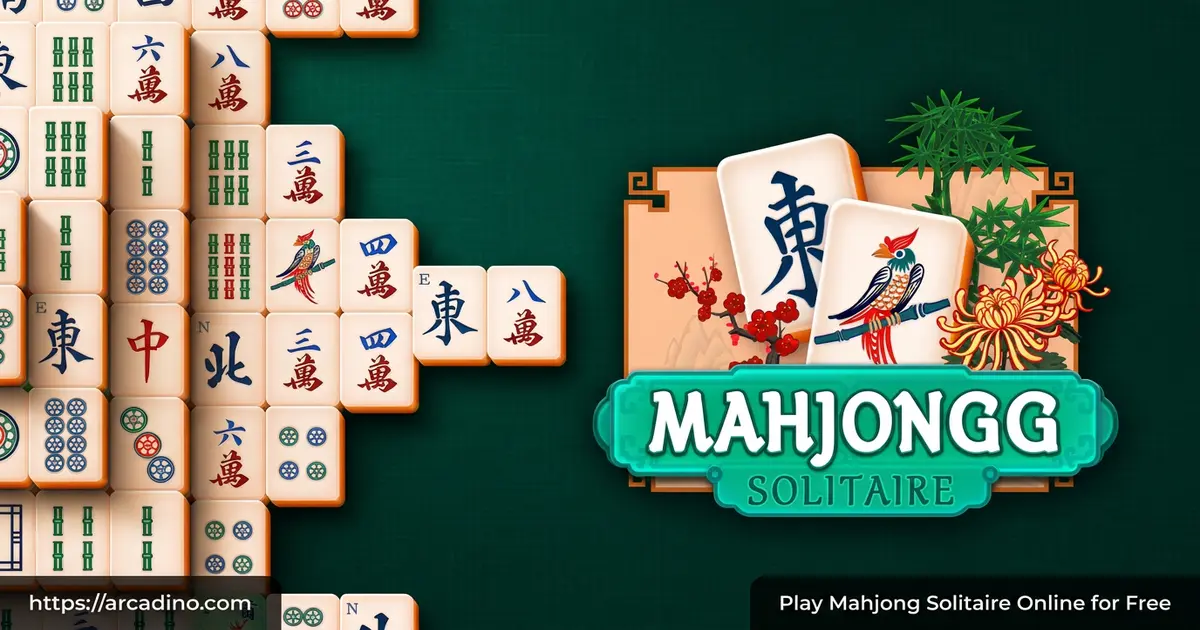
- Match pairs of free tiles to clear the whole board.
- Multiple layouts including turtle, pyramid, fish, bird and gate.
- Helpful hint, undo and shuffle tools when you get stuck.
- Seven tile suits with special flowers and seasons.
What Is Mahjong Solitaire?
Mahjong Solitaire is a single-player puzzle game built from the tiles of traditional four-player Mahjong. Instead of competing with others, you race against your own brain to clear a stacked board of 144 tiles. It’s sometimes called Shanghai Solitaire, and millions of players boot it up for a relaxing think-session.
The game loads almost instantly in any modern browser, which is one reason it has stayed popular for decades. Tiles look crisp on both laptops and phones, and clicking pairs feels snappy without lag. I tested it on a school-style Chromebook and the board scrolled smoothly with no stutter. That kind of reliability matters when you’re hunting for one last matching pair.
Gameplay in Mahjong Solitaire
The goal is straightforward: remove every tile by matching identical pairs. A tile counts as “free” if nothing covers it and either its left or right side is open. Click two free tiles that match, and they vanish from the stack.
Most matches use exact pairs from suits like circles, bamboos, characters, winds and dragons. Flowers and seasons are special, though. Any flower can pair with any other flower, and any season can pair with any other season. That little twist gives you flexible moves when the board gets tight.
How the 144 Tiles Break Down
The full set has a clear structure once you peek inside. There are 36 circle tiles, 36 bamboo tiles and 36 character tiles, each with four copies of numbers one through nine. Winds add 16 more, with four copies each of north, south, east and west. Dragons bring 12 tiles, with four copies of red, green and white dragons. Finally, four unique flowers and four unique seasons round out the 144. Knowing this layout helps you predict which matches are still possible.
Layouts and Tile Suits
You’re not stuck with one shape. Common layouts include the classic turtle, plus pyramid, fish, bird and gate setups. Each one stacks tiles differently, so the same matching rules feel like a new puzzle every time.
The seven suits each carry their own point value, with wans worth the least and seasons the most. Knowing which tiles score higher helps when you’re chasing a big finish. If you forget which symbol is which, tile labels can usually be toggled in the settings.
Tile Suit Point Values and Meanings
Each suit also carries cultural meaning from old China. Here’s the point ladder most online versions follow:
- Wans (Characters) – 2 points. They represent “myriads” or ten-thousands of coins.
- Circles (Dots) – 4 points. These show stacks of round coins.
- Bamboos (Sticks) – 6 points. They picture strings used to tie coins together.
- Winds – 8 points. North, south, east and west stand for the four directions.
- Dragons – 10 points. Red, green and white dragons bring luck and power.
- Flowers – 12 points. Plum, orchid, chrysanthemum and bamboo mark the seasons of growth.
- Seasons – 14 points. Spring, summer, autumn and winter are the rarest matches.
Win-Rate Comparison Across Layouts
Not every board is equally beatable, and the shape you pick changes your odds. Here’s a rough comparison based on player data:
- Turtle – around 14% win rate. Best for beginners thanks to balanced stacking.
- Pyramid – around 12%. A bit tighter, but still kid-friendly.
- Gate – around 10%. Long side rows trap pairs late in the game.
- Fish – around 9%. Curvy edges hide tiles in awkward spots.
- Bird – around 7%. The hardest of the bunch, best saved for experts.
If you’re just starting out, stick with turtle until you can clear it twice in a row. Then try pyramid and gate to stretch your planning skills. Save fish and bird for when you crave a real challenge.
Hints, Undo and Shuffle Tools
Stuck on the board? Mahjong Solitaire gives you three lifelines. The hint button highlights one available pair, undo rewinds your last move, and shuffle rearranges remaining tiles when no moves are left.
Use these wisely. Hints often pick the first match the game finds, not the smartest one. Undo is fantastic for peeking under a tile to plan ahead, then rewinding if the move wasn’t worth it.
How to Play Mahjong Solitaire
Getting started takes about ten seconds. Pick a layout, wait for the tiles to deal, and start scanning for matching pairs. Look at the whole pyramid before clicking anything, because your first few moves shape the rest of the game.
Remember that only tiles with an open left or right side can be matched. Tiles trapped between others stay locked until you free them. The game usually grays out unavailable tiles, which makes spotting valid pairs much easier for younger players.
Controls for Mahjong Solitaire
Controls are mouse-only on desktop and tap-only on mobile. Click or tap one free tile, then click its identical twin to remove the pair. On phones and tablets, pinch to zoom if the tiles look small on a busy layout.
Tips and Tricks for Mahjong Solitaire
- Clear the top of the pyramid early. The very top tile blocks four others underneath it, so freeing it opens up huge chunks of the board.
- Target horizontal rows and corner tiles next. These are notorious for trapping pairs late in the game.
- Watch for triples and quads. If three or four identical tiles are visible, pick the pair that unblocks the most other tiles.
- Use undo as a scout. Make a match, peek at what’s underneath, then rewind if the reveal isn’t useful.
- Save shuffle for emergencies. It’s tempting to mash it early, but it’s far more valuable when you’ve truly run out of legal moves.
- Watch the “open matches” counter at the top of the screen. It shows how many legal pairs you can still play. Aim to keep that number high, because a low count means the board is close to locking up.
Common Beginner Mistakes to Avoid
New players tend to trip on the same few traps. The biggest one is clicking the first matching pair you spot instead of scanning the whole board first. Another mistake is ignoring flowers and seasons because they look different from the numbered suits. Those flexible matches are some of your best escape moves, so use them when the board feels tight. Beginners also mash the shuffle button too early, burning their safety net before they really need it. Finally, lots of kids forget that picking the wrong tile of a triple can lock the matching pair under heavy stacks. Always look for which copy frees the most tiles below.
Key Features of Mahjong Solitaire
- 144 tiles arranged in classic stacked layouts that test memory and planning.
- Seven tile suits including special flower and season bonus pairs.
- Multiple board shapes so each session feels different.
- Built-in hint, undo and shuffle tools for friendlier play.
- Runs free in any browser with no signup or download required.
Mahjong Solitaire vs. Four-Player Mahjong
People mix these two up all the time, so here’s a clear side-by-side. They share tiles but feel like totally different games.
- Players – Solitaire is one player; classic Mahjong needs four.
- Objective – Solitaire clears all 144 tiles; classic Mahjong builds a winning hand of 14 tiles.
- Tile count in use – Solitaire uses all 144 stacked; classic Mahjong deals 13 per player from the same set.
- Scoring – Solitaire scores by tile values and speed; classic Mahjong scores by hand patterns and bonuses.
- Skill type – Solitaire rewards planning and memory; classic Mahjong adds bluffing, reading opponents and luck of the draw.
If you enjoy the solo version, the four-player game is a fun next step once you know the suits by sight.
Where to Play Mahjong Solitaire
The fastest way to play Mahjong Solitaire is right here in your browser on Arcadino. There’s no account, no download, and no waiting for a launcher. Just load the page, pick a layout, and start matching tiles.
If you want it on the go, official mobile versions are available too. Grab it on Google Play for Android or on the App Store for iPhone and iPad. Stick to those official stores rather than random APK sites, which can hide unsafe files. The browser version also runs full-screen on PC if you prefer the bigger view.
For Parents
Mahjong Solitaire is one of the calmest puzzle games out there, and it’s friendly for kids ages 8 and up. There’s no chat, no violence, and no scary themes. The browser version on Arcadino has no in-app purchases to worry about.
It also sneaks in real brain benefits. Players practice pattern recognition, short-term memory and forward planning every round. Sessions are short, usually 10 to 20 minutes, which makes it easy to fit between homework breaks.
Accessibility and Classroom Use
Mahjong Solitaire is one of the more accessible puzzle games online. Most browser versions let you toggle tile labels, which is a huge help for colorblind players and kids still learning the Chinese symbols. The slow, untimed pace suits children with ADHD because there’s no pressure or flashing rewards rushing them. Teachers also use it during quiet reading time, since the gentle clicks don’t disturb a classroom. Mouse and tap controls keep it simple for younger kids who aren’t ready for complex keyboard combos. Screen-reader support is limited, but the visual design uses strong color contrast on most modern versions. Pair it with calm music for a brain break that feels almost like meditation.
Is Mahjong Solitaire Good for the Brain?
Yes, this style of tile-matching is often recommended as a gentle mental workout. Spotting pairs, planning ahead and tracking blocked tiles all stretch focus and working memory. It’s a calmer alternative to fast reflex games.
Similar Games to Mahjong Solitaire
If matching pyramids of tiles is your thing, these puzzle classics scratch the same itch.
- Pyramid Solitaire – Pair cards that add up to 13 from a card pyramid layout.
- TriPeaks Solitaire – Clear three card peaks by picking cards one rank above or below the last.
- Golf Solitaire – Strip the tableau by removing cards in rising or falling sequences.
- Spider Solitaire – Build long suited sequences across ten columns using two decks.
- FreeCell Solitaire – Move every card to the foundations using four free cells and smart planning.
- Classic Mahjong – The original four-player tile game where you build winning hands against rivals.
Browse more brain teasers in our Puzzle category.
FAQs About Mahjong Solitaire
How do you play Mahjong Solitaire?
You play by matching pairs of identical free tiles to clear the board. A tile is free when nothing sits on top of it and either its left or right side is open. Flowers can match any flower, and seasons can match any season. You win when every tile is gone.
How do you set up Mahjong Solitaire online?
The online version sets itself up automatically when you pick a layout. Choose turtle, pyramid, fish, bird or gate, and the game deals all 144 tiles for you. There’s no shuffling or stacking by hand like the physical version.
Is Mahjong Solitaire free to play?
Yes, Mahjong Solitaire is completely free to play in your browser. There’s no signup, no payment, and no download needed. The mobile app versions are also free to install, though they may include ads.
Can you play Mahjong Solitaire alone?
Yes, Mahjong Solitaire is designed as a one-player game. The traditional four-player Mahjong is a different version. The solitaire variant uses the same tiles but a totally different goal: clear the stack instead of building winning hands.
Is Mahjong Solitaire good for the brain?
Yes, it’s widely seen as a healthy brain exercise. The game pushes pattern recognition, planning, and memory. Kids who play regularly often get faster at spotting matches and thinking several moves ahead.
How do you play Mahjong Solitaire for beginners?
Start with the turtle layout, which has the highest win rate. Always scan the full board before your first click and aim for tiles that unlock several others. Use hints sparingly so you build your own pattern-spotting skills.
How difficult is Mahjong Solitaire?
It’s considered medium to hard, depending on the layout. According to player data shared by Mahjong sites, the turtle layout wins about 14.17% of the time, while trickier setups dip below 10%. Smart planning beats luck more often than people think.
Is every Mahjong Solitaire puzzle solvable?</h3
On most quality browser versions, including the one on Arcadino, every deal has at least one valid solution. That means if you get stuck, the issue is the moves you made, not the board itself. Using undo to backtrack or shuffle as a last resort almost always opens a fresh path. So yes, with smart play, every puzzle can be cleared.
Ready to Clear the Board?
Mahjong Solitaire mixes ancient tiles, modern browser convenience and a real test of foresight. Five layouts, seven suits and the trio of hint, undo and shuffle tools give every round its own flavor. Pick a pyramid, find that first pair, and see how deep into the stack you can go before the board locks up.
Gameplay Video