























Watch one short ad and play ad-free for 30 minutes.
Triple Solitaire
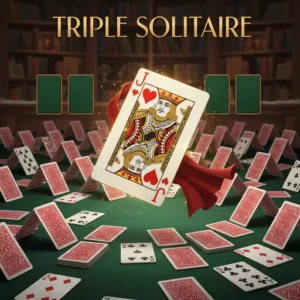
Various (public domain)If regular Solitaire feels too quick, Triple Solitaire flips the table with three full decks and 156 cards. It’s a free browser card game you can play online instantly, no download needed. Think of it as Klondike’s bigger cousin, often searched alongside klondike solitaire turn 3 by players hunting a longer round. You’ll juggle 13 tableau columns, a chunky stockpile, and 12 foundation piles all at once. 🃏
Triple Solitaire rewards patience over speed, and every win feels earned. It’s the kind of card puzzle where one smart move can unlock a whole cascade.
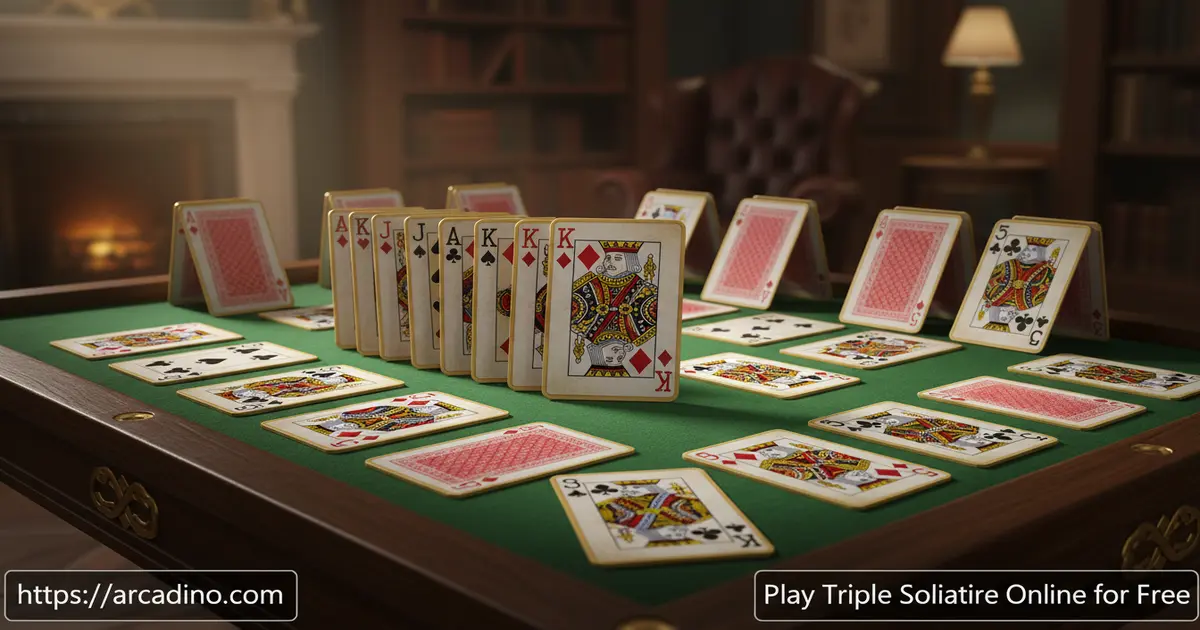
- Three full decks shuffled into one massive 156-card game
- 12 foundation piles, with three piles per suit, Ace to King
- Turn 1 and Turn 3 stockpile options for easy or harder play
- Free to play in any browser, plus mobile apps available
What Is Triple Solitaire?
Triple Solitaire is a three-deck version of classic Klondike Solitaire. Instead of one deck and four foundations, you get three decks and twelve foundations. The goal stays the same: move every card to the foundations by suit, Ace through King. It’s a marathon round rather than a sprint.
Players often confuse this title with plain klondike solitaire, since the rules are nearly identical. The big difference is scale. From my own play sessions, the browser version loads in just a couple of seconds, and dragging card stacks feels smooth even on a basic laptop. The bigger board fits cleanly on most modern screens without any awkward scrolling.
Triple Solitaire Gameplay
The core loop is simple but the board is huge. You deal 91 cards into 13 columns, where column one has a single card and column 13 has thirteen. Only the bottom card of each column starts face-up. The remaining 65 cards sit in the stockpile, waiting to be flipped to the waste pile.
You build downward in the tableau in alternating colors, like a black 7 on a red 8. You build upward in the foundations by suit, starting with each Ace. Empty columns can only be filled by a King or a King-led sequence. That last rule matters a lot when you’ve cleared a column and don’t have a King handy.
You can also move whole sequences as a group, not just one card at a time. If you’ve built a sorted red 5, black 4, red 3 stack, you can drag the entire run onto a black 6. This shifts big chunks of the board with a single click. Group moves are key to freeing buried face-down cards quickly.
Turn 1 vs Turn 3 in Triple Solitaire
The stockpile has two flavors. In Turn 1, you flip one card at a time from the stock to the waste, which gives you maximum control. In Turn 3, you flip three cards at once and only the top one is playable, making the round trickier.
Turn 1 is the friendlier mode for newcomers. Turn 3 is the version most veterans pick when they want a real brain workout. Both share the same goal and the same 156-card layout.
Levels and Progression in Triple Solitaire
There aren’t traditional levels here. Each game is one big puzzle, but the deal is random, so no two rounds feel the same. Some sessions you’ll cruise through; others you’ll get stuck behind a wall of buried cards.
Many versions of the game track wins, fastest times, and streaks in a stats panel. Climbing your own personal best is the real progression. If you want competition, look for builds with leaderboards that pit your scores against other players.
Win Rate and Round Length
Triple Solitaire has a win rate of roughly 33% to 42%, depending on the mode and how often you use undo. Turn 1 sits near the top of that range, while Turn 3 is closer to the bottom. An average round takes about 15 to 25 minutes, much longer than the 3 to 5 minutes of classic Klondike. So if you only win one out of every three games, that’s totally normal, not bad luck.
Why Players Love Triple Solitaire
The appeal is that bigger board, fuller of choices. With three copies of every card, you almost always have a backup plan if one path closes. That makes the game feel less punishing than classic Klondike, even though rounds run longer.
It’s also a great wind-down game. There’s no timer pressure unless you want one, and the click-and-drag pace lets your brain settle into a calm rhythm. Many fans say it’s their go-to before bed or during a break.
A Cascade Move in Action
Cascades are the magic moment in Triple Solitaire, so here’s a real example. Say you flip the stockpile and reveal a red Ace of Hearts. You send it to the foundation, which uncovers a black 2 of Clubs in column 4. The 2 also flies up to its own foundation, freeing a red 3 of Diamonds underneath. Now you spot a black 4 at the bottom of column 9, so you drag the red 3 onto it. That move frees a face-down card in column 4, which flips to reveal a red King. You drop the King into the empty column you cleared two turns ago. One Ace just triggered five plays in a row, and that’s a cascade.
How to Play Triple Solitaire
Getting started takes about 10 seconds. Open the game, pick Turn 1 or Turn 3, and the deal happens automatically. You’ll see the tableau spread across the middle, the stockpile and waste in the top-left, and the 12 foundation slots up top.
Click any Ace to send it to the foundations. Drag face-up cards onto other tableau cards that are one higher and the opposite color. When you run out of moves, click the stockpile for fresh cards.
Remember you can grab a whole sorted run at once. Click the top card of a clean alternating-color sequence and the cards below it come along. That’s the fastest way to swap big stacks between columns.
Controls for Triple Solitaire
On desktop, use your mouse to click and drag cards. Double-clicking a card usually sends it straight to its foundation if a legal slot exists. Depending on the build, many versions support keyboard shortcuts like Space to grab a card, Z to undo, F to flip the deck, H for a hint, and P to pause. Check the in-game help menu to see which shortcuts your version uses. On phones and tablets, tap and drag with your finger.
Screen Size and Mobile Layout Tips
Because there are 13 columns instead of 7, the board needs more space to breathe. We recommend a screen at least 10 inches wide for comfy play, like a tablet, laptop, or desktop. On phones in portrait mode, the columns squeeze together and cards overlap heavily, so most builds switch to a side-scrolling or zoomed view. Flipping your phone to landscape gives you a much better look at all 13 columns at once. If text or cards still feel tiny, use your browser’s pinch-to-zoom or Ctrl + scroll to bump things up. Chromebooks and full-size tablets are the sweet spot for the big board.
Tips and Tricks for Triple Solitaire
- Send Aces and 2s to the foundations the moment they appear. Low cards block columns fast in a three-deck game.
- Focus on the longest tableau columns first, since they hide the most face-down cards.
- Don’t fill an empty column with a King unless you actually need to. Sometimes holding the slot open is smarter.
- Watch the color of your Kings. If you have three red Kings already placed, wait for a black one before filling the next empty column.
- In Turn 3, pay attention to which cards rotate into view after each pass. Pulling one card from a trio shifts what shows up next time.
- Balance your suit progression so all four suits climb together. Don’t let one foundation race up to 10 while another is stuck on a 3, because you’ll need those mid-rank cards to land tableau moves later.
Compare Triple Solitaire to Other Solitaire Games
Picking the right solitaire variant depends on how much time you have and how tough you like it. Here’s a quick side-by-side:
- Klondike Solitaire – 1 deck, 52 cards, win rate around 43%, average round 3 to 5 minutes. The easy classic.
- Double Solitaire – 2 decks, 104 cards, win rate around 38%, average round 8 to 12 minutes. A solid middle step.
- Triple Solitaire – 3 decks, 156 cards, win rate around 33 to 42%, average round 15 to 25 minutes. The big-board marathon.
- Spider Solitaire – 2 decks, 104 cards, win rate around 30% on 4-suit mode, average round 10 to 20 minutes. Trickier sequencing.
If you want a quick break, Klondike wins. If you want a long, satisfying puzzle with lots of backup plans, Triple is the pick.
Key Features of Triple Solitaire
- Three standard decks combined for a 156-card challenge with 12 foundation piles
- Two difficulty modes via Turn 1 (draw one) and Turn 3 (draw three)
- Customizable stockpile passes on many builds: one pass, three passes, or unlimited
- Undo button so you can roll back risky moves and learn safer paths
- Auto-play options on the mobile app that send obvious cards straight to the foundation
Where to Play Triple Solitaire
The fastest way in is right through your browser. Triple Solitaire runs on desktop, laptop, Chromebook, phone, and tablet without any install. There’s no signup wall, and the game works in Chrome, Firefox, Safari, and Edge.
Want it on your phone for offline play? Grab the mobile versions here: Google Play Store for Android and App Store for iOS. Stick with the official store links rather than random APK sites, since unofficial downloads can carry malware. On a school or home computer, the browser version is the cleanest choice.
For Parents
Triple Solitaire is a great fit for ages 8 and up. The rules teach planning, sequencing, and patience, all without any violence or scary content. There’s no chat feature, so kids aren’t exposed to strangers while playing.
The browser version is free and typically ad-supported. The mobile apps may include optional in-app purchases for themes or hints, so check store settings if that’s a concern. A 20 to 30 minute session is a nice balance, since rounds run longer than regular Solitaire.
Similar Games to Triple Solitaire
If you enjoy the big-board feel of this three-deck variant, these card games scratch the same itch:
- Klondike Solitaire – The single-deck classic that started it all, and the game most newcomers learn first.
- Double Solitaire – A two-deck middle ground between Klondike and Triple, faster to finish but still meaty.
- Spider Solitaire – Another large-deck card game where you build long sequences across ten columns.
- FreeCell Solitaire – A logic-heavy variant with four free cells for parking cards, almost always winnable with smart play.
- TriPeaks Solitaire – A breezier pyramid-style game for when you want a quick card fix.
- Yukon Solitaire – A Klondike cousin with no stockpile, where every card is dealt face-up from the start.
- Pyramid Solitaire – A pairing game where you match cards that add up to 13 to clear a pyramid.
- Forty Thieves – An expert-level two-deck challenge with strict rules and a famously low win rate.
Browse more in the Card Games category for the full lineup.
FAQs About Triple Solitaire
Is Triple Solitaire free to play?
Yes, Triple Solitaire is completely free in your browser. There’s no signup, no download, and no paywall to get past. Mobile apps are also free, though they may show ads or offer optional extras.
How many cards are in Triple Solitaire?
Triple Solitaire uses 156 cards from three standard 52-card decks. Of those, 91 are dealt into the tableau and 65 go into the stockpile. You’ll work them all into the 12 foundation piles to win.
Is Triple Solitaire the same as Klondike Solitaire?
It’s a three-deck version of Klondike, with the same core rules. The differences are bigger board size, 12 foundations instead of 4, and a much longer round. Players searching for klondike solitaire turn 3 are usually looking for this exact format.
What’s the difference between Turn 1 and Turn 3?
Turn 1 flips one stockpile card at a time, while Turn 3 flips three at once. Turn 1 gives you more control and is easier. Turn 3 only lets you play the top card of each trio, which adds real difficulty.
Can you play Triple Solitaire offline?
The browser version needs an internet connection to load. Once loaded, some builds keep working if you lose Wi-Fi mid-game. The Google Play and App Store apps let you play fully offline after install.
How do you win Triple Solitaire?
You win by moving all 156 cards to the 12 foundation piles. Each foundation builds up by suit from Ace to King. When every pile is complete, the game is over and you’ve cleared the board.
Can you play triples in regular Solitaire?
No, classic Solitaire uses one deck and four foundations only. “Triples” refers specifically to three-deck variants like this one. If you want the triple-deck experience, you need a game built for it.
Ready to Shuffle Up?
Triple Solitaire takes everything that makes Klondike satisfying and stretches it across three decks, 13 columns, and 12 foundations. The optional Turn 1 and Turn 3 modes let you pick your difficulty, and the undo button means no mistake is ever permanent. Grab a quiet 20 minutes, deal the cards, and see how many foundations you can finish before the stockpile runs dry.
Gameplay Video