



























Watch one short ad and play ad-free for 30 minutes.
Spider Solitaire
Various (public domain)If you love card games that make your brain work a little harder than regular solitaire, Spider Solitaire is the perfect challenge. It’s free, runs right in your browser, and uses two full decks instead of one. You’ll juggle ten columns of cards, build long runs from King down to Ace, and try to clear the whole table. Sometimes people just call it “solitaire,” but Spider Solitaire is its own twist with bigger decks and trickier rules.
This version is great for kids who want a puzzle that rewards careful thinking. Every move matters, and one wrong tap can block a card you really need. 🕷️
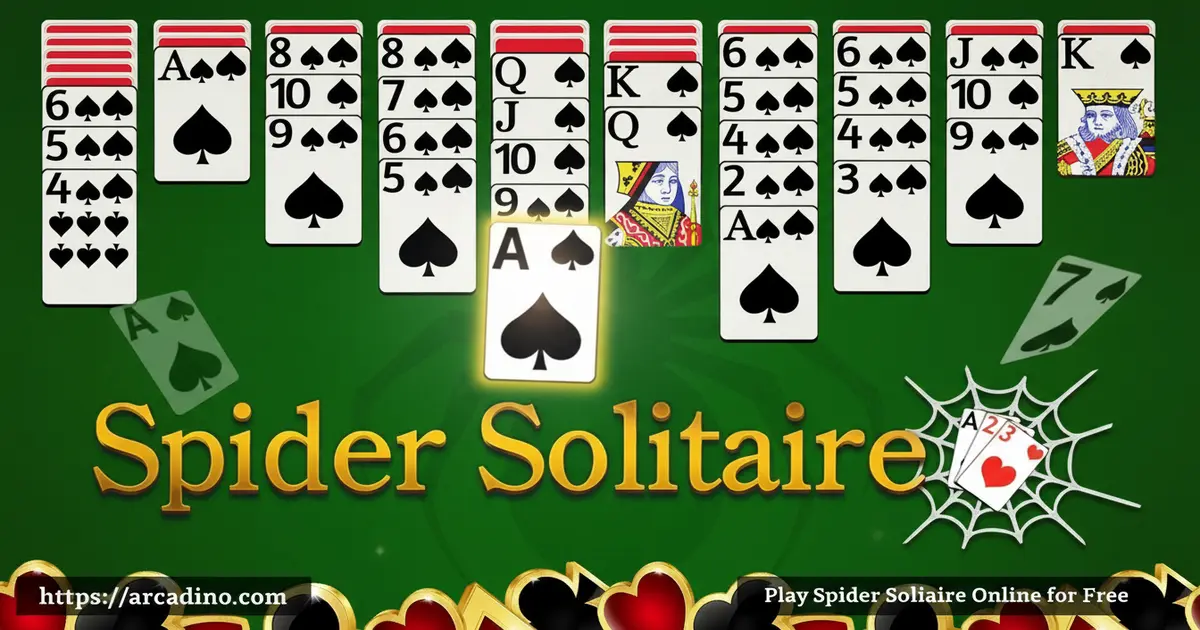
- Three difficulty modes: 1 suit, 2 suits, and 4 suits
- Uses 104 cards split across 10 tableau columns
- Eight foundation piles to fill before you win
- Plays instantly in any browser, no signup needed
What Is Spider Solitaire?
Spider Solitaire is a classic patience card game played with two decks. Your goal is to sort all 104 cards into eight complete runs, each going from King down to Ace in the same suit. When you finish a run, it disappears from the tableau and lands on a foundation pile. Clear all eight piles and you win.
The game has a long history. Spider-style patience games date back to the early 1800s, but most kids today know it because Microsoft added it to Windows in the early 2000s. That free copy on millions of computers turned Spider Solitaire into one of the most-played card games ever.
What makes this title stand out is the difficulty ladder. The 1-suit version uses only Spades, so beginners can learn without worrying about color matching. The 4-suit version mixes every suit and is brutal even for experienced players.
Playing in the browser, I noticed how smoothly the cards drag between columns. There’s no lag when you tap the stockpile to deal ten new cards. Animations feel snappy, which matters when you’re undoing a move and rethinking your whole plan.
Gameplay in Spider Solitaire
The game starts with 54 cards spread across ten columns. The first four columns hold six cards each, and the last six columns hold five cards each. Only the top card in each column is face up. The remaining 50 cards sit in the stockpile, waiting to be dealt.
You move face-up cards onto cards that are exactly one rank higher. A 7 of Hearts slides onto an 8 of any suit. That mixed-suit placement is allowed on the tableau in every mode. But here’s the key catch: a full King-to-Ace run only clears to a foundation pile if every card in it shares the same suit. Mixed-suit runs stay stuck on the table.
There’s another important rule about moving groups. You can only pick up a stack of cards together if they’re all the same suit and in descending order. Mixed-suit stacks have to be moved one card at a time.
When you run out of moves, you click the stockpile. It deals one new face-up card to the bottom of every column. You can do this five times total, since 50 cards divided by 10 columns equals five deals. One strict rule trips up new players: you cannot deal from the stockpile if any column is empty. You must fill every empty column with a card first, which can force tough choices.
A Worked Example: One Smart Move
Imagine this spot on the table. You have a neat 9♠-8♠ same-suit run sitting in one column. In another column there’s a loose 8♥ on top of a face-down card. Up top, a 10♣ is ready to receive an 8 or a 9. Which 8 do you move?
It’s tempting to move the 9♠-8♠ run onto the 10♣ because it looks tidy. But that breaks nothing new open. Move the loose 8♥ onto the 9♠ instead, and you flip a face-down card in its old column. Then you can still slide the 9♠ stack onto the 10♣ later if you want. Revealing hidden cards almost always beats keeping a pretty run intact.
Difficulty Modes in Spider Solitaire
The 1-suit mode is your training ground. Every card is a Spade, so you only worry about rank order. Many guides report win rates around 60% in 1-suit mode, though your actual results depend a lot on skill and how strict the rules are.
The 2-suit mode adds Hearts to the mix. Rank-only placement still works just like in 1-suit, but you can only move groups when they share a suit. Completed runs only clear if every card matches.
The 4-suit mode is the real test. All four suits are in play, which means more blocked sequences and tighter strategy. Winning this mode feels amazing because it’s genuinely hard.
Scoring and Progress
You start each game with 500 points. Every move you make subtracts one point, so efficient play earns higher scores. Each completed King-to-Ace run adds 100 bonus points. Finish three runs in 70 moves and you’d be sitting at 730 points.
This scoring system rewards thinking before tapping. Rushing through moves drains your score fast. Slow, planned play almost always beats quick guessing in Spider Solitaire.
How to Play Spider Solitaire
Getting started is simple. Open the game in your browser, pick a difficulty, and the cards deal themselves. Click or tap a face-up card to pick it up, then drop it onto a card one rank higher. The interface handles the rest.
Try the 1-suit version first if you’ve never played before. Once you can win consistently, move to 2 suits. Save 4 suits for when you really understand how to manage empty columns and face-down reveals.
Controls for Spider Solitaire
On desktop, click and drag cards between columns or tap to auto-move them. Use Ctrl+Z to undo a move and Ctrl+H if you need a hint. On mobile, tap a card to select it, then tap the destination column. Drag-and-drop also works on touchscreens for players who prefer it.
Empty Column Economy
Think of empty columns as the most valuable currency in Spider Solitaire. One empty column lets you park any single card or same-suit run while you dig through a buried column. Two empty columns let you split a mixed-suit stack and rebuild it in the right order, which is often the only way to untangle a stuck board.
Try to hold at least one empty column before tapping the stockpile. Pros aim for two empty columns in 4-suit mode, because the next deal will fill every column with a fresh card. “Spending” an empty column to flip several face-down cards is usually worth it. Finishing a partial run early, on the other hand, often wastes the workspace you could have used to fix the rest of the board. When in doubt, save the empty column and dig deeper instead.
Tips and Tricks for Spider Solitaire
- Flip face-down cards as fast as possible. Hidden cards are the biggest obstacle, so revealing them opens new moves.
- Create empty columns when you can. An empty column is a free workspace where any card or sequence can land.
- Build long sequences on high cards like 10s and Jacks. Starting runs at the top gives you room to add more cards underneath.
- Don’t tap the stockpile too early. New cards can block sequences you’ve already built, so use every move first.
- Use the undo button when a move backfires. Going back one step costs you a point but can save the whole game.
Key Features of Spider Solitaire
- Three difficulty levels covering beginner to expert play
- Uses two full decks for longer, deeper games than standard solitaire
- Ten tableau columns plus eight foundation piles
- Built-in undo and hint tools to help new players learn
- Scoring system that rewards efficient, thoughtful moves
Where to Play Spider Solitaire
The easiest way is right here in your browser. No download, no sign-up, just click and the deal begins. It works on Chrome, Firefox, Safari, and Edge on both desktop and mobile.
Want it on your phone? You can grab the MobilityWare version on Google Play or the App Store. Stick with these official downloads instead of random APK files, which can carry unwanted software.
The browser version is also handy at school or in libraries where installing apps isn’t allowed. Just open the page and the game loads.
For Parents and Teachers
Spider Solitaire is one of the safest card games for kids. There’s no chat, no multiplayer lobbies, and the browser version doesn’t push purchases. The mobile apps may show ads or offer optional upgrades, so check settings before handing over a device.
The game builds planning skills, pattern recognition, and patience. Kids ages 8 and up can handle 1-suit mode, and older players will enjoy working toward 4-suit wins. A 15 to 20 minute session is a comfortable play length.
Classroom and Learning Benefits
Spider Solitaire quietly trains some of the same skills schools care about most. Players use working memory to track which face-down cards have been revealed, sequence planning to chain moves several steps ahead, and delayed gratification to skip a quick win for a stronger long-term position. Recognizing rank order also reinforces basic number sense for younger kids.
For session length, ages 8 to 10 do well with 10 to 15 minute rounds of 1-suit mode. Ages 11 to 13 can handle 20 to 30 minute 2-suit games. Teachers can use 1-suit mode as a 5-minute math or logic warm-up, asking students to plan one move out loud before tapping. It’s a calm, screen-friendly way to start a lesson without any login or noise.
Similar Games to Spider Solitaire
If you enjoy the slow-burn strategy of Spider Solitaire, these card puzzles offer the same satisfying brain workout.
- Klondike Solitaire – The classic single-deck solitaire most people grew up playing, with seven tableau columns instead of ten.
- FreeCell – A solitaire variant with four free cells for temporary card storage, where almost every deal is winnable.
- Pyramid Solitaire – Pair cards that add up to 13 to clear a pyramid-shaped layout.
- TriPeaks Solitaire – Clear three peaks of cards by selecting cards one rank above or below the current card.
- Spiderette – A smaller, single-deck cousin of Spider Solitaire with seven columns and faster rounds.
- Crown Solitaire – A modern twist that mixes Spider-style stacking with crown-shaped layouts and bonus goals.
- Mahjong Solitaire – Match pairs of tiles to clear a layered board, perfect if you like quiet pattern puzzles.
Browse more in Card Games.
FAQs About Spider Solitaire
How do you play Spider Solitaire?
You arrange cards in descending runs from King to Ace in the same suit. Move face-up cards onto cards one rank higher, and use the stockpile when you run out of moves. Complete all eight foundation runs to win.
How do you set up Spider Solitaire?
Deal 54 cards across ten columns, with the first four columns holding six cards and the rest holding five. Only the top card of each column is face up. The remaining 50 cards form the stockpile.
What is Spider Solitaire?
Spider Solitaire is a two-deck patience game with 104 cards. You sort cards into eight same-suit runs from King to Ace. It’s been popular since the early 1800s and became famous through Microsoft Windows.
Is Spider Solitaire the same as regular Solitaire?
No, Spider Solitaire is a different variant with two decks and ten columns. Regular solitaire (Klondike) uses one deck and seven columns. The goals and rules are also quite different.
Is Spider Solitaire free to play online?
Yes, Spider Solitaire is completely free in your browser. There’s no download, no registration, and no fees. You can play unlimited games whenever you want.
What is the easiest version of Spider Solitaire?
The 1-suit version is the easiest, using only Spades. Without color matching, beginners can focus on rank order alone. Win rates here are often around 60%.
Can you always win Spider Solitaire?
No, not every deal is winnable, especially in 4-suit mode. Smart play increases your odds, but some hands are simply too blocked. The 1-suit mode gives the best chance of winning.
Final Thoughts on Spider Solitaire
Spider Solitaire packs a lot into a simple card layout. Two decks, ten columns, three difficulty modes, and a scoring system that pushes you to play smarter every round. The 1-suit mode welcomes beginners, while 4 suits will keep you coming back to chase that elusive win.
Grab a chair, pick your difficulty, and see how many foundation piles you can clear in one sitting.
Gameplay Video