


























Watch one short ad and play ad-free for 30 minutes.
Slender: The Eight Pages
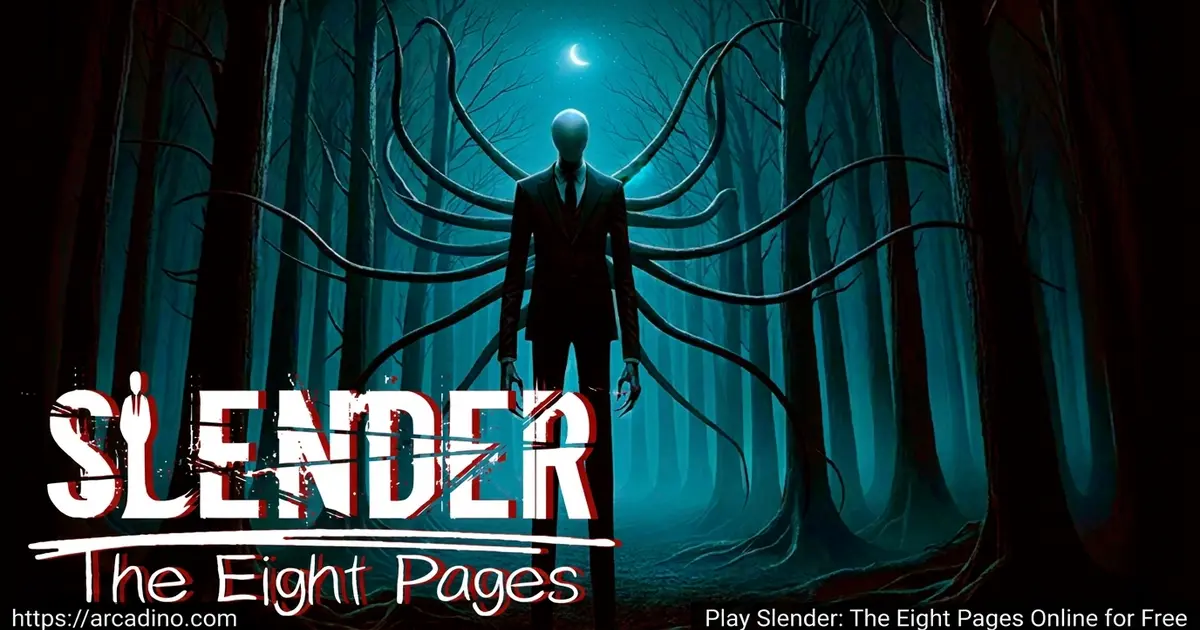
Parsec ProductionsFew horror games hit harder with fewer tools than Slender: The Eight Pages. You’re alone in a pitch-black forest with a flashlight, a fading battery, and one goal: find eight scribbled manuscript pages before the faceless figure finds you. The game is free to play online in your browser, and it still terrifies people more than a decade after its release. Often just called “Slender,” this indie experiment by Mark J. Hadley turned a creepypasta myth into a genuine cultural moment. 🔦
Here’s what makes Slender: The Eight Pages stand out:
- Eight randomly placed pages to collect across a dark woodland map
- No weapons, no attacks – your only defense is running
- A flashlight battery that drains and forces tense, dark moments
- Sanity meter that drops the longer you stare at Slender Man
What Is Slender: The Eight Pages?
Slender: The Eight Pages is a first-person survival horror game built by Parsec Productions and creator Mark J. Hadley. It was released back in 2012 as a free experimental project, and it exploded in popularity through Let’s Play videos on YouTube. The game is based on the Slender Man mythos, the tall faceless figure born from internet creepypasta and Marble Hornets. It’s a minimalist scare machine – no story cutscenes, no NPCs, just you and the woods.
The Marble Hornets connection is huge here. That YouTube series turned the Slender Man legend into found-footage horror, with shaky cameras, missing friends, and creepy scribbled notes left in the woods. The eight pages you collect borrow directly from those notes – the same shaky handwriting, the same “HELP ME” panic. If you’ve ever watched Marble Hornets, the forest will feel eerily familiar.
What really sells the dread is how little the game gives you. There’s no inventory, no health bar in the traditional sense, and no way to fight back. I loaded it up in a browser tab and the atmosphere kicked in within seconds – that low crickets-and-static ambience is half the scare. The controls feel light and the flashlight beam reads the trees clearly, which makes every shadow worth checking twice.
Version History and the Renaming
The game started life simply as “Slender” in June 2012 as a free beta. Early builds like v0.9.5 and v0.9.6 already had the forest and the pages, but lacked polish. With version 0.9.7 in August 2012, Mark J. Hadley renamed it to “Slender: The Eight Pages.” This set it apart from the upcoming sequel, Slender: The Arrival. The renamed build added small tweaks but kept the core scare loop intact. That’s why some old YouTube videos still call it just “Slender.”
Gameplay in Slender: The Eight Pages
The loop is brutally simple. You wander a fenced-in forest at night looking for eight manuscript pages stuck to landmarks like trucks, trees, bathrooms, and a stone wall. Each page has poorly scribbled drawings of the Slender Man with phrases like “HELP ME” or “NO NO NO.” You can grab them in any order, and their locations shuffle every run.
Every page you collect makes Slender Man more aggressive. He teleports closer, appears in your flashlight beam, and starts cutting off paths. Looking at him directly drains your sanity fast, so you have to glance and sprint. Get caught staring too long and the screen distorts into static – that’s the game over.
The Flashlight and Sanity System
Your flashlight is your lifeline, but the battery is on a timer. Use it constantly and you’ll be stumbling through pitch black before page five. Smart players flick it off when they’re sure no one’s near, saving juice for the panicked sprints later on.
Sanity ties everything together. Sprinting drains stamina, the flashlight drains battery, and Slender Man drains your sanity. Balancing all three is the real puzzle of this eight pages game, and it’s why short runs feel so loaded with tension.
Maps and Atmosphere in Slender
The original release centers on a single dark forest map with a perimeter fence you can’t cross. Some versions and community builds add extra environments like winter and autumn variants, which change the visual tone but keep the same rules. The cramped trees, fog, and limited sightlines do the heavy lifting on every map.
Audio is where this slenderman game really wins. Crickets chirp softly until a page is grabbed, then drums punch in, footsteps thud, and a piano stab tells you he’s near. It’s lo-fi but devastatingly effective.
The 10 Page Spawn Landmarks
The pages always stick to one of about ten landmarks scattered around the forest. Knowing every spot saves precious battery and stops you wandering empty woods. Here’s the full list players sweep on every run:
- The big trucks – two rusted vehicles near the starting area
- The bathroom building – a small concrete restroom block
- The tunnel – a short pipe you can walk through
- The silo – a tall round tower visible from far away
- The stone wall – a long ruin in the middle of the woods
- The dead tree cluster – a circle of big leafless trunks
- The oak tree – a single huge tree standing alone
- The forked tree – a tall tree split into two trunks
- The fuel tanks – rusty cylinders by the fence line
- Smaller landmark trees – a couple of marked trunks near paths
An Optimal First-Run Route
Want to actually beat the game on your first try? Try this route. Start by sweeping the trucks right at spawn – they’re free and fast. From there, head to the bathroom building nearby. Next, push toward the tunnel, since it’s a clear chokepoint that’s easy to scan. Hit the fuel tanks and stone wall on your way deeper. Save the silo for later only if you have to – it sits in open ground where Slender Man patrols hard. The big lone trees should be your final stops, because by then he’s teleporting everywhere. Move in a rough circle, never backtrack, and keep your flashlight off between landmarks. Most failed runs come from zigzagging across the map and burning battery.
Why Players Love Slender: The Eight Pages
This is the game that made streaming horror reactions a thing. Watching someone scream at a faceless suit in HD became a whole genre of YouTube content, and Slender sits at the root of it. The short runs – often around 15 to 20 minutes – make it perfect for replaying with friends watching.
People also love how restrained it is. There’s no jump-scare overload, no cheap gore. The fear comes from anticipation, from the gap between hearing the piano cue and actually seeing him standing between two trees.
How to Play Slender: The Eight Pages
Getting started takes about ten seconds. Open the game in your browser, click to begin, and you’ll spawn near the forest entrance with your flashlight already in hand. There’s no tutorial – you just start walking. Find a landmark, scan it with your flashlight, and grab any page you see.
Controls for Slender: The Eight Pages
- WASD – move forward, back, and strafe
- Mouse – look around the forest
- Left Shift – jog or sprint (drains stamina)
- Left Mouse Click – pick up pages
- F or Right Mouse Click – toggle flashlight
- Q and E – zoom in and out
Browser Performance and Technical Tips
The WebGL build runs smoothly on most laptops at 60 frames per second. Older Chromebooks may dip to 30, but the game still plays fine. Press F11 to go fullscreen – it hides browser tabs and makes the dark forest feel huge. Headphones are not optional here. The piano sting that warns you Slender Man is near is hard to hear on tinny laptop speakers. If your flashlight beam looks washed out or grey, bump up your monitor contrast or play in a darker room. Close other tabs before starting, because audio glitches kill the tension. A wired mouse helps too, since trackpads make sharp turns feel sluggish.
Accessibility and Comfort Tips
This game leans hard on flashing static and quick visual shocks. If you have photosensitivity or get migraines from strobing, skip the late-game static screen or take breaks after every two pages. To fight motion sickness, zoom out with Q for a wider field of view and run in short bursts instead of long sprints. Lower your mouse sensitivity if turning feels dizzy. Audio is the main scare vector, so don’t try to play this with sound off – you’ll miss every warning cue and feel cheated. Subtitles aren’t needed, since there’s no dialogue. Take a breather between runs if your heart’s pounding – it’s just a game, and the woods will still be there. 🌲
Tips and Tricks for Slender: The Eight Pages
- Turn the flashlight off when safe. Battery is precious. If you’re in an open spot with no piano cue, save power for later pages.
- Never stare at him. Glance to confirm he’s there, then immediately look away and sprint perpendicular. Direct eye contact drains sanity fastest.
- Hug landmarks. Pages are always on objects – trucks, restrooms, the silo, the stone wall, big trees. Skip the empty woods between them.
- Listen for the drum. The audio cue when he’s close is your warning. Move before he appears in your beam.
- Keep moving. Standing still is a death sentence after page four. He spawns behind static players almost instantly.
Key Features of Slender: The Eight Pages
- First-person survival horror with no combat at all
- Eight randomly placed pages that reshuffle every run
- Dynamic difficulty – Slender Man gets faster with each page found
- Flashlight battery, stamina, and sanity systems working against you
- Short, replayable sessions ideal for streaming or playing with friends watching
Where to Play Slender: The Eight Pages
The easiest way is right here in your browser – free, instant, no installer needed. The web build runs cleanly on Chrome, Firefox, Safari, and Edge, and it loads without any sign-up wall. You can also grab the original Windows and Mac builds from the developer’s site if you want the full desktop experience.
Mobile versions exist too. You can download Slender: The Eight Pages on Google Play for Android or get it from the App Store for iPhone and iPad. Stick to official stores – sketchy APK sites often bundle malware with horror game downloads.
For Parents
Slender: The Eight Pages is a horror game and is best suited for older kids around 12 and up, depending on how easily they spook. There’s no blood, no gore, and no swearing – the scares come purely from atmosphere, sound, and the faceless figure appearing unexpectedly. The game has no chat features, no in-app purchases, and no microtransactions in the browser version. Sessions are short, usually under 20 minutes, which makes it easy to set a one-or-two-run limit for younger players.
Similar Games to Slender: The Eight Pages
If the lo-fi forest dread of this slenderman pages game hooked you, these browser horror picks scratch the same itch:
- Slender: The Arrival – the official sequel with better graphics, more levels, and a full storyline about a missing friend.
- Granny – first-person hide-and-survive horror in a creaky house with a deaf villain who hears every footstep.
- Five Nights at Freddy’s – sit-still survival horror against animatronics, all atmosphere and timing.
- Eyes the Horror Game – explore a haunted mansion collecting bags of cash while a ghost hunts you.
- The Man from the Window – short, tense indie horror with a faceless lurking figure.
Browse more spooky picks on the Horror games category.
FAQs About Slender: The Eight Pages
Is Slender: The Eight Pages free?
Yes, Slender: The Eight Pages is completely free to play. It was released as a free experimental project in 2012 by Parsec Productions, and the browser version costs nothing. You can also download the original desktop build at no charge.
Is this the same game as Slender?
Yes, “Slender” is the original name of Slender: The Eight Pages. It was renamed starting with version 0.9.7 to distinguish it from the sequel. Many players still search for it just as “Slender,” and both names point to the same forest-and-pages game.
How do you beat Slender: The Eight Pages?
You beat it by collecting all eight manuscript pages without losing your sanity. Move between landmarks like the trucks, restrooms, silo, and stone wall. Keep your flashlight off when possible, sprint in short bursts, and never look directly at Slender Man.
Where are the eight pages located?
The pages spawn on around ten landmarks scattered through the forest, but their exact spots reshuffle each run. The common spawn points are the two trucks, the bathroom building, the tunnel, the silo, the stone wall, the fuel tanks, the dead tree cluster, the oak tree, the forked tree, and a few marked landmark trees. Sweep these spots in order instead of wandering open ground.
Is Slender: The Arrival a sequel to The Eight Pages?
Yes, Slender: The Arrival is the direct sequel released in 2013. It features a young woman investigating her missing friend in the same woods, and one chapter is a full remake of The Eight Pages. The Arrival has better graphics, more levels, and an actual storyline.
Is there a multiplayer version of Slender: The Eight Pages?
The original 2012 release is single-player only. There’s a separate standalone game called “Slender Man: The Eight Pages (NEW)” on Steam, made by a different team, which adds LAN and online multiplayer. It’s not a mod of the original – it’s a remake by other developers. So if you want co-op, you’ll need that separate Steam version, not the browser build.
How long does it take to finish Slender: The Eight Pages?
A successful run usually takes 15 to 20 minutes. The game is designed for short, intense sessions rather than long playthroughs. Many players replay it dozens of times because the page locations and Slender Man’s behavior change every round.
Does Slender: The Eight Pages work on mobile?
Yes, official mobile versions are available on Google Play and the App Store. Touch controls handle movement, looking, and the flashlight. The browser version is also playable on tablets in landscape mode.
Final Thoughts on Slender: The Eight Pages
More than ten years later, Slender: The Eight Pages still works because it understands restraint. Eight pages, one flashlight, one faceless stalker – and that’s enough for some of the tensest minutes you’ll spend in a browser. The random page placement and escalating aggression mean no two runs feel identical, which is why people keep coming back.
Grab a pair of headphones, dim the lights, and see how many pages you can pull off the trees before the static catches you.
Gameplay Video